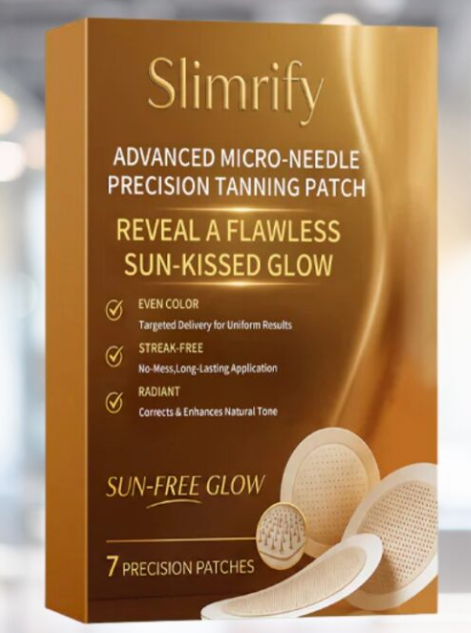

A patch that gives you a tan without the sun sounds almost too good to be true. That’s exactly why the Slimrify Sun-Free Glow Patch has been getting attention online. The product is marketed as an advanced microneedle tanning patch that supposedly helps stimulate melanin production from within, allowing users to develop a natural-looking tan without UV exposure, tanning beds, sprays, or self-tanners. It’s a bold claim.
Most people understand how tanning traditionally works. Your skin is exposed to UV radiation, melanin production increases, and the skin darkens over time. Slimrify presents a completely different idea: apply a patch, let the microneedles deliver active ingredients, and support a gradual sun-free glow. The concept is intriguing enough to make almost anyone curious.
In this review, we’ll break down what the Sun-Free Glow Patch actually claims to do, whether the science appears convincing, and why I became increasingly skeptical as I looked deeper into the marketing.
Quick Takeaways
- Slimrify markets the product as a microneedle tanning patch
- Claims focus on stimulating melanin production without UV exposure
- The science behind sun-free tanning patches remains extremely limited
- Microneedle technology sounds impressive but doesn’t automatically validate the tanning claims
- The marketing relies heavily on before-and-after imagery and transformation messaging
- The concept is far more ambitious than the evidence currently available
Table of Contents
- Quick Takeaways
- What Is the Slimrify Sun-Free Glow Patch?
- The Microneedle Technology Is Doing Most Of The Selling
- The Tanning Claims Are Where Things Get Complicated
- Why The Before-And-After Photos Matter
- What Realistically Might Happen?
- A Pattern I Keep Seeing
- Is The Slimrify Sun-Free Glow Patch Legit or a Scam?
- What To Do If You Already Ordered
- Conclusion
- Slimrify Sun-Free Glow Patch FAQ
What Is the Slimrify Sun-Free Glow Patch?
The Slimrify Sun-Free Glow Patch is marketed as a transdermal beauty patch that uses dissolvable microneedles to deliver ingredients through the skin.
According to the marketing, these ingredients help support melanin production, which is the pigment responsible for skin color and tanning.
The appeal is obvious.
No sunburn.
No tanning bed exposure.
No self-tanner smell.
No streaks.
Just a patch that’s supposed to help your body create a natural-looking tan. If that sounds like a breakthrough, you’re probably having the same reaction many buyers have when they first see the ads.
The Microneedle Technology Is Doing Most Of The Selling
One thing became clear very quickly while researching this product. The microneedle angle is carrying a huge amount of the marketing weight.
Terms like:
advanced delivery system, precision microneedles, transdermal technology, and nano absorption make the product sound highly scientific. The issue is that a delivery method and a proven result are not the same thing.
Microneedles are a legitimate technology used in various medical and cosmetic applications. That doesn’t automatically mean every claim attached to a microneedle product has been validated. That’s where a lot of buyers get tripped up.
The Tanning Claims Are Where Things Get Complicated
This is the biggest hurdle for me. The product isn’t simply claiming to improve skin appearance or hydration. It’s claiming to help create a visible tan without traditional UV exposure. That’s a much bigger claim.
When you start looking for strong evidence supporting over-the-counter tanning patches that reliably create noticeable skin darkening, the science becomes much thinner than the marketing.
The concept sounds innovative. The supporting evidence is much harder to find.
Why The Before-And-After Photos Matter
Many tanning products rely heavily on visual proof because tanning is something people can easily see. Slimrify follows that same pattern. The marketing often focuses on dramatic comparisons, visible glow improvements, and transformation-style imagery.
The challenge with these types of visuals is that consumers rarely know:
lighting conditions, editing, timelines, other products used, or whether individual results are representative of typical outcomes.
Visual marketing can be extremely persuasive even when the underlying evidence remains limited.
What Realistically Might Happen?
This is where expectations become important. Some users may feel like they’re taking part in a cutting-edge beauty trend and genuinely enjoy the experience.
Others may notice little or no visible tanning effect and wonder whether the patch is doing anything meaningful at all.
That’s a common outcome whenever marketing promises results that are difficult to verify independently.
A Pattern I Keep Seeing
Slimrify fits into a pattern I keep seeing across products like the Sun-Free Glow Patch, Meta Melt Drops, and Coffee and Peppers Peptides.
The formula is always similar: a real-sounding delivery system like microneedles is introduced, then used to support much bigger claims around transformation. In the case of the tanning patch, the messaging shifts from skin support to visible sun-free tanning, which is a much stronger claim than the underlying evidence usually supports.
That gap between “supporting a process” and “creating a visible result” is where expectations tend to get stretched.
Is The Slimrify Sun-Free Glow Patch Legit or a Scam?
The product itself appears to be a real item that consumers can purchase. The bigger question is whether the tanning claims are supported strongly enough to justify the expectations created by the marketing. That’s where I remain cautious.
The idea of a patch that produces a visible tan without UV exposure is a much bigger claim than the evidence currently seems to support.
What To Do If You Already Ordered
If you’ve already purchased the patch, approach it more as an experimental beauty product than a guaranteed tanning solution. Pay attention to your own results rather than relying on marketing expectations.
It’s also worth checking return policies, subscription terms, and future billing arrangements if the purchase was made through a promotional funnel.
Conclusion
The Slimrify Sun-Free Glow Patch is one of those products that sounds futuristic immediately. A tanning patch is a much more exciting story than another bottle of self-tanner. But exciting ideas and proven results are not always the same thing.
The microneedle technology may be real. The concept is certainly creative. Whether the average user will experience the kind of visible tanning transformation shown in the marketing is a much harder question to answer.
Slimrify Sun-Free Glow Patch FAQ
Does the Slimrify Sun-Free Glow Patch actually give you a tan?
The company claims the patch supports melanin production and helps create a natural-looking tan without UV exposure. However, strong independent evidence supporting dramatic tanning results from patches remains limited.
How does the Sun-Free Glow Patch work?
The patch uses dissolvable microneedles designed to deliver ingredients through the skin. The marketing suggests these ingredients support the body’s natural tanning processes.
Is the Slimrify tanning patch safer than tanning beds?
The patch does not involve UV exposure, which removes the risks associated with tanning beds and excessive sun exposure. However, that doesn’t automatically mean the tanning claims themselves are proven.
How long does it take to see results?
The marketing often suggests relatively quick results, but actual experiences may vary significantly from person to person.
Can a patch increase melanin production?
That’s one of the central claims behind the product. The challenge is that evidence supporting over-the-counter tanning patches as a reliable way to create noticeable skin darkening remains limited.
Is the Slimrify Sun-Free Glow Patch legit or a scam?
The product appears to be a real product that consumers can purchase. The bigger question is whether the tanning results shown in marketing materials accurately reflect what most users should realistically expect.