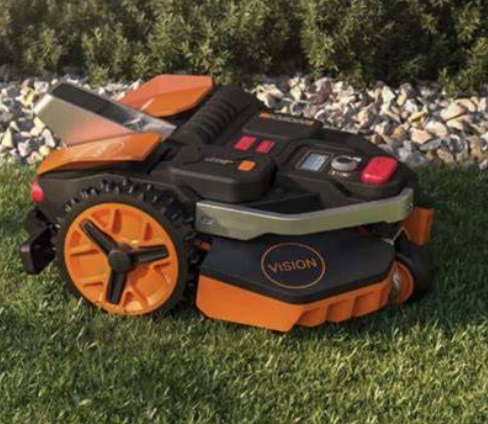

Robot lawn mowers are starting to get marketed like they’ve finally solved yard work forever. The WORX Landroid Vision 4WD WR344 pushes that idea hard. No perimeter wires. AI vision. Four-wheel drive. Autonomous mowing that supposedly handles rough terrain without much human involvement.
The videos make it look effortless. Perfectly cut lawns, smooth navigation, clean turns around obstacles. The kind of product that makes you think mowing might actually become something you never deal with again.
Then you start looking at how people are actually living with these things.
Quick Take
- Marketed as a wire-free AI robotic mower built for difficult terrain
- The technology behind it is genuinely more advanced than older robot mowers
- Real-world performance still seems inconsistent depending on yard layout and software behavior
- Firmware complaints and navigation frustrations keep appearing in owner discussions
- Overall impression: impressive idea with real potential, but still feels like technology that occasionally fights the user instead of helping them
Table of Contents
- Quick Take
- What the WORX Landroid Vision 4WD WR344 Is Supposed to Do
- The Marketing Looks Smoother Than Real Ownership
- The Software Side Seems to Frustrate People More Than the Hardware
- What Owning Something Like This Probably Feels Like
- A Pattern I Keep Seeing
- Is the WORX Landroid Vision 4WD WR344 Legit?
- Conclusion
What the WORX Landroid Vision 4WD WR344 Is Supposed to Do
The biggest selling point here is the wire-free system. Older robot mowers usually depend on buried perimeter wires to understand lawn boundaries. The WR344 tries to replace all of that with cameras, AI recognition, RTK positioning, and smart navigation systems.
In theory, that’s a huge upgrade. Nobody enjoys installing boundary wires across a yard. And the idea of a mower that can visually understand where it should and shouldn’t go sounds genuinely futuristic.
The 4WD system is another major part of the marketing. WORX positions this mower as something designed for slopes, uneven ground, rough terrain, and larger properties that would normally challenge robotic mowers.
The concept itself is real. This isn’t fake technology. The problem is that lawns are unpredictable environments, and that’s where things start getting messy.
The Marketing Looks Smoother Than Real Ownership
One thing I kept noticing while researching the WR344 was how controlled the demos feel compared to real user experiences.
The ads usually show:
- perfectly maintained grass
- open visibility
- clean property lines
- bright daylight
- minimal obstacles
Real yards rarely look like that.
A lot of people have:
- uneven terrain
- muddy patches
- toys in the grass
- narrow pathways
- trees blocking visibility
- awkward landscaping
- patchy lawn sections
And this seems to be where the mower starts behaving less predictably. Some owners describe days where the system works beautifully, then suddenly struggles with navigation or gets stuck in places that shouldn’t even confuse it.
That inconsistency keeps showing up in discussions around AI-powered lawn equipment.
The Software Side Seems to Frustrate People More Than the Hardware
This was probably the biggest thing that stood out during research. The mower itself sounds mechanically capable. The climbing ability and traction get praised fairly often compared to standard robotic mowers.
The complaints usually shift toward software. People mention:
- firmware updates causing new issues
- navigation glitches
- mapping problems
- app instability
- random stop errors
- inconsistent route behavior
And the frustrating part is that some users say the mower performs great right before an update changes everything.
That’s becoming a pattern with smart home products lately. The hardware may be solid, but the experience becomes dependent on software stability that keeps changing over time.
What Owning Something Like This Probably Feels Like
This feels like one of those products where the experience depends massively on expectations. If someone buys this expecting:
“a fully autonomous lawn robot that completely replaces mowing forever”
…there’s a good chance frustration starts creeping in pretty quickly.
But if someone views it more like:
“an advanced maintenance tool that still needs occasional supervision”
…the experience probably becomes much better.
Because the technology does seem capable in the right conditions.
Open lawns, manageable terrain, fewer obstacles, and stable weather conditions appear to give the mower a much smoother experience overall. The more complicated the property becomes, the more the system seems to show its limitations.
A Pattern I Keep Seeing
The WR344 reminded me a lot of what I noticed while researching the Bcdroid A10 Ultra Robot Vacuum. Different product. Same emotional pitch.
Take a chore people hate:
- vacuuming
- mowing
- scrubbing
- cleaning floors
Then market automation like human involvement is basically over. That’s the real thing being sold here: freedom from maintenance.
And while robotic lawn technology has improved massively, the marketing still pushes this almost “perfect autonomous machine” image that reality hasn’t fully caught up to yet.
Is the WORX Landroid Vision 4WD WR344 Legit?
Yes. This is a real robotic mower with advanced technology behind it. The AI navigation, RTK positioning, and four-wheel-drive system are all legitimate features within the robotic mower space. The skepticism comes more from how consistently the system performs once it leaves controlled demo environments and enters real properties with real obstacles.
My overall impression is that the WR344 probably feels extremely impressive in the right yard and much more frustrating in complicated ones. That difference matters more than the marketing suggests.
Conclusion
The WORX Landroid Vision 4WD WR344 feels like a product sitting right in the middle of where smart outdoor tech is heading.
The technology itself is impressive. Wire-free mowing, AI navigation, and better terrain handling are real upgrades over older robotic mowers. But the ownership experience still seems tied heavily to software stability, yard conditions, and realistic expectations.
The mower probably works best for people who understand they’re buying evolving automation technology, not a flawless replacement for lawn care forever.
Because once real-world terrain, weather, and software inconsistency enter the picture, the “perfect autonomous mowing” image starts looking a lot less perfect.
Also read my honest review on ANTHBOT M5 Robot Lawn Mower