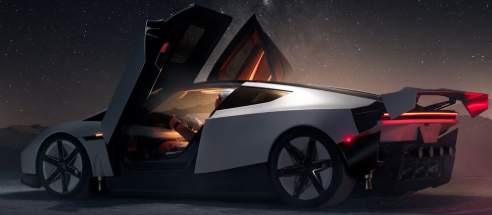

Tesla has just shown off a car that can jump over other vehicles, drive upside down, and briefly fly through the air. I watched the new Roadster demonstration with a mixture of excitement and disbelief because, until recently, the biggest promise surrounding this car was how fast it could go. Now Elon Musk wants to take things much further. But there’s something I find equally interesting. Tesla first announced this Roadster in 2017, started taking reservations, and promised deliveries in 2020. Nine years later, nobody has received the new model, and Tesla is now talking about 2028. The car has changed considerably during that time, including its design, seating capacity, driving range, and the technology it uses. Some of those changes are impressive, while others leave me wondering whether the finished Roadster will be as practical as it is exciting.
In this review, I’ll look at what Tesla demonstrated in October 2026, how the new technology works, what buyers can expect, and whether the Roadster is worth reserving before production begins.
Quick Takeaway
- Car: Tesla Roadster, second generation
- Manufacturer: Tesla, with SpaceX-developed technology
- Latest unveiling: October 15, 2026
- Expected production: 2028
- Original advertised price: Starting at $200,000; new prices haven’t been confirmed
- Acceleration: Under one second from 0 to 60 mph claimed for the Thrust version
- Top speed: More than 230 mph claimed
- Driving range: More than 300 miles, compared with the original 620-mile promise
- Versions: Performance, Thrust, and Rocket
- Reservations: $50,000 for Performance and $250,000 for Thrust
- Verdict: The technology is fascinating, but I wouldn’t reserve one until Tesla confirms the final price, specifications, and delivery schedule.
Table of Contents
- Quick Takeaway
- What Has Changed About the Tesla Roadster?
- Tesla Roadster Performance and SpaceX Technology
- Can the Tesla Roadster Really Fly?
- Battery Range, Handling, and Everyday Driving
- Tesla Roadster Price, Reservations, and Release Date
- Is the Tesla Roadster Worth Buying? My Verdict
What Has Changed About the Tesla Roadster?
The Roadster isn’t a completely new idea. Tesla actually sold its first Roadster between 2008 and 2012, and it was one of the cars that helped show electric vehicles could be exciting rather than just economical. The second-generation model was announced in November 2017 with some extraordinary promises. Tesla said it would have four seats, accelerate from 0 to 60 mph in 1.9 seconds, travel 620 miles on a single charge, and reach speeds above 250 mph. That was enough to get people talking, especially when electric supercars were still relatively uncommon. The Roadster unveiled in October 2026 is quite different. It now has a much lower, sharper appearance, narrow hidden headlights, large lightweight wheels, and doors that open upwards. Tesla has also reduced the seating to two people in the regular versions, while the Rocket version has just one seat. Inside, there’s a steering yoke instead of a traditional round steering wheel, a large central touchscreen, and two smaller displays in front of the driver. Tesla has used materials such as carbon fibre, magnesium, and titanium to reduce weight, which makes sense for a car built around extreme performance. I like the new design because it looks like a proper supercar without being unnecessarily strange. But I do wonder how comfortable it will be. The fixed seating arrangement and unusual steering system may help reduce weight, but they also need to work for different drivers. Tesla hasn’t yet provided independent road tests showing what the finished interior feels like or how the car handles ordinary driving. For now, we’re looking at a very advanced prototype, not a production car that customers have been able to live with.
Tesla Roadster Performance and SpaceX Technology
The Roadster’s performance claims are difficult to ignore. During the October 15 demonstration, Tesla showed a prototype accelerating from 0 to 60 mph in approximately 0.81 seconds. That’s nearly 100 kilometres per hour in less than a second. For comparison, the original 2017 Roadster was already considered extremely fast with its promised 1.9-second acceleration time. Tesla has now more than doubled the ambition, and the company isn’t relying on electric motors alone to achieve it. The Thrust version uses compressed-gas thrusters developed with help from SpaceX, Elon Musk’s rocket company. These work by releasing highly pressurised gas in a controlled direction, pushing the car forward. Think about what happens when you release an inflated balloon without tying the opening. The escaping air sends it flying across the room. Tesla is using a much more sophisticated version of that principle to help the Roadster accelerate. The advantage is that the thrusters can provide extra force without depending entirely on the tyres gripping the road. Tesla also claims the Roadster can exceed 230 mph, although its final production performance hasn’t been independently established. What interests me is how all this technology will behave outside a carefully prepared demonstration. How often can the thrusters be used before the compressed-gas supply needs replenishing? Will the system work consistently during repeated acceleration runs? And how much maintenance will it need? These are reasonable questions because a car that performs one incredible stunt isn’t necessarily one that will remain reliable after years of ownership. The engineering deserves credit, but I would wait for independent testing before treating Tesla’s figures as established production-car records.
Can the Tesla Roadster Really Fly?
This is probably the feature that will attract the most attention, even from people who have no interest in cars. During the unveiling at SpaceX’s Texas facility, Tesla demonstrated a Roadster prototype driving up a curved structure until it was upside down, then leaving the structure, turning in the air, and landing on its wheels. Another demonstration showed it jumping over several Tesla vehicles. The car uses two unusual systems to perform these movements. The first is a powerful fan system underneath the body that removes air from below the car, creating suction that helps hold it against the road or another surface. Imagine how a suction cup sticks to a smooth surface, although the Roadster uses a much more complicated system to produce the effect. The second is the compressed-gas thrusters, which can push the vehicle in different directions. Together, they allow movements that ordinary cars simply cannot perform. But there’s an important catch. Tesla is offering three versions of the Roadster, and only the most extreme one is designed for flight. The Performance version is a two-seat road car with the suction system and adjustable aerodynamic equipment. The Thrust version adds rear-mounted thrusters for extraordinary acceleration. The Rocket version has additional thrusters positioned around the vehicle, allowing it to lift off the ground and rotate while airborne. It seats one person, is available by invitation only, and Tesla explicitly says it isn’t approved for public-road use. So no, buying a Roadster doesn’t mean you’ll be allowed to fly over traffic whenever the road gets congested. Tesla has demonstrated brief aerial movements, not sustained flight like an aeroplane. The demonstration vehicle was also operated without a human driver for safety reasons. I find the technology impressive, but I’m not convinced that flying should be a priority for a road car. I’d be more interested in knowing how safely and reliably these systems work during normal driving, particularly around other motorists.
Battery Range, Handling, and Everyday Driving
For all the attention given to the Roadster’s acceleration and flying abilities, there’s surprisingly little confirmed information about how the finished car will perform during everyday use. One major change is its driving range. Tesla originally promised 620 miles on a single charge, but the redesigned Roadster is now being advertised with more than 300 miles. That’s still roughly 480 kilometres, which is perfectly reasonable for many journeys, but it’s a significant reduction from the original promise. Tesla hasn’t provided independently verified range results or complete final charging specifications, so it’s difficult to know what owners should realistically expect. I also wonder how much energy the Roadster’s additional systems will consume, particularly during repeated high-performance driving. Then there’s the handling. Tesla says its suction system can improve grip even when the car isn’t moving, while adjustable aerodynamic parts help it remain stable at different speeds. That’s interesting because most performance cars rely heavily on airflow over their bodies to generate additional grip, which becomes less effective at low speeds. Tesla’s powered fan system could offer an advantage in certain situations. But the Roadster will still need to handle ordinary roads, uneven surfaces, rain, debris, and the kind of conditions people encounter outside a racetrack. How will the underside system cope with loose stones or road damage? What happens if part of it stops working? Tesla hasn’t yet answered those questions through independent long-term testing. There are already electric supercars, including the Rimac Nevera, that have demonstrated extraordinary acceleration and reached customers. The Roadster may eventually outperform them, but until buyers can drive the finished vehicle, I think it’s too early to declare it the best electric supercar.
Tesla Roadster Price, Reservations, and Release Date
The Roadster’s price is another area where buyers need to be careful. When Tesla announced the car in 2017, it advertised a starting price of $200,000, with a limited Founders Series costing $250,000. Those figures are still widely repeated, but Tesla hasn’t confirmed the final selling price of the redesigned Roadster. Given how much the car has changed, I wouldn’t assume the original pricing will remain valid. What Tesla has confirmed is the cost of securing a reservation. The Performance version requires a total reservation payment of $50,000, while the Thrust version requires $250,000. The initial payment is $5,000, with the balance due shortly afterwards. That’s a substantial amount of money to commit to a vehicle that isn’t in production. Tesla’s reservation agreement makes clear that the payment doesn’t constitute a completed vehicle purchase. It secures an approximate place in line, and the company says it cannot guarantee when the car will be delivered. Customers can cancel and receive a refund before entering the final purchase agreement, but I’d still be cautious about tying up that much money. The delivery history doesn’t help. Tesla originally expected the Roadster to arrive in 2020, then postponed it repeatedly while focusing on other projects. Production is now expected to begin in 2028, eleven years after the original unveiling. And even if Tesla starts building the car that year, there’s no guarantee every reservation holder will receive one immediately. I understand that developing unusual technology takes time, but there’s a limit to how much patience buyers should be expected to have. At this point, I would rather wait for confirmed production specifications, independent reviews, and a realistic delivery schedule before paying anything.
Is the Tesla Roadster Worth Buying? My Verdict
I like what Tesla is trying to do with the Roadster. The car looks good, the engineering is genuinely unusual, and the performance demonstrations show why people are still interested after so many years. The combination of electric motors, a powered suction system, and SpaceX thrusters could make it one of the most remarkable performance cars ever produced. But I wouldn’t recommend reserving one today. Tesla has shown what its engineers can make a prototype do, not what customers will necessarily experience in a finished vehicle. We still don’t know the final price, independently verified performance, long-term reliability, or exactly when deliveries will begin. I’m also not convinced that giving a supercar the ability to briefly fly makes it a better car to own. For someone who collects rare vehicles and can comfortably afford the reservation, I can understand wanting to be among the first buyers. But for anyone looking at the Roadster as a serious purchase, waiting makes much more sense. Tesla has had nearly nine years to develop this car, and another two years are now being requested. The October demonstration was impressive, but I’d rather see the Roadster prove itself on ordinary roads before calling it worth the money.
You can also check my review of Garmin MARQ Gen 3 here