
I came across an advert for the German Graphene Wall Heater showing a slim panel that supposedly warms up in just three seconds. That alone caught my attention, but the other promises were even bigger. The seller claimed it could heat a room as large as 200 square metres, use only 1 kWh of electricity for a whole day and cut heating costs by up to 60%. It sounded like the sort of heater people would love to have, especially with electricity bills being what they are. But I wasn’t convinced by the video alone. I wanted to know how much heating power this little panel actually produces and whether the technology behind it could deliver everything the advert promised.
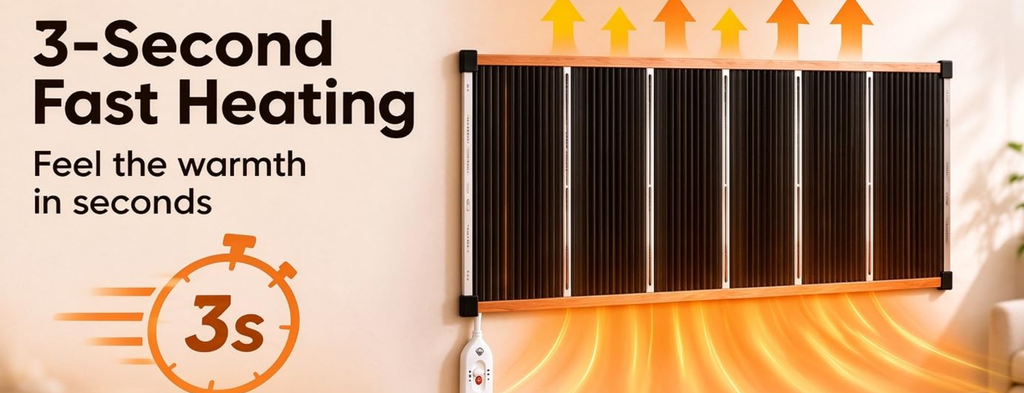
Table of Contents
- What Is the German Graphene Wall Heater?
- Can It Really Heat a 200m² Room in Three Seconds?
- What About the 1 kWh Electricity Claim?
- Is the Heater Safe, and What Do Buyers Say?
- Is the German Graphene Wall Heater Worth Buying?
- Frequently Asked Questions
What Is the German Graphene Wall Heater?
The German Graphene Wall Heater is advertised as a slim electric panel that attaches to a wall and produces warmth using graphene-based heating technology. Unlike a conventional portable heater, it is designed to take up very little space, and some adverts describe it as an infrared heating panel. Graphene is a real material with useful electrical and thermal properties. Researchers have even studied flexible graphene heating elements, including work involving scientists from the Technical University of Munich. So the technology itself isn’t imaginary. The problem is that I couldn’t find evidence connecting that research to this particular heater. The adverts mention German laboratories and university involvement, but I found no reliable documentation showing that a German university developed this product or that it is manufactured in Germany. The name gives it a German identity, but that isn’t proof of its origin.
Can It Really Heat a 200m² Room in Three Seconds?
This is where the advert started losing me. It claims the panel can reach 60°C in three seconds and heat an area of up to 200m². Those are two very different things. A thin heating element might become hot quickly because there’s very little material to warm up. But getting the panel hot isn’t the same as bringing an entire room to a comfortable temperature. A 200m² space is considerably larger than an ordinary bedroom or living room, and it needs a substantial amount of heating power. An ISOLED heating guide gives indicative requirements of around 25 watts per square metre for a well-insulated passive house and 80 watts for a poorly insulated building. For a 200m² property, that works out to roughly 5,000 to 16,000 watts. A small wall panel rated at 200 or 400 watts simply wouldn’t provide that level of heating on its own. It might offer some warmth nearby, but that’s a very different promise from heating an entire house. I haven’t found an independent test showing this particular heater warming a 200m² space or proving that the room reaches a comfortable temperature in seconds.
What About the 1 kWh Electricity Claim?
The advert also makes the heater sound incredibly cheap to run, claiming it can provide a full day of warmth with just 1 kWh of electricity. The actual power rating matters here. A 200-watt heater uses 0.2 kWh every hour, so it would consume 1 kWh after five hours of continuous use. A 400-watt model would use that same amount in two and a half hours. To average just 1 kWh over an entire 24-hour period, the heater would need to consume approximately 41.7 watts on average. A thermostat could reduce consumption by switching the heater on and off, but that doesn’t mean the panel can run at full power all day using only 1 kWh. The promised 60% savings also need some explanation. The adverts don’t clearly show what heating system the comparison is based on, how long each system runs or what room conditions were used. Without those details, the percentage is just a marketing claim rather than a reliable estimate of what buyers will save. We have looked at similar electricity-saving promises in our Cozy Cove Pro Heater review, where the advertised room coverage also needs to be considered alongside the actual wattage.
Is the Heater Safe, and What Do Buyers Say?
The adverts describe the panel as waterproof, burn-proof and safe for children. Those claims sound reassuring, but I couldn’t find independent test reports or safety certificates for this particular model to back them up. With an electrical heater, I’d expect clear information about its voltage, wattage, temperature controls, overheat protection and installation requirements. Buyers should also be able to identify the exact model they’re ordering and check the safety documentation before installing it. I also came across similar heating panels being promoted under different names, but that doesn’t automatically mean they’re all identical or faulty. Seller-hosted ratings and testimonials don’t provide much reassurance on their own, and I haven’t found enough independently verified buyer feedback to establish how this particular model performs after regular use. That’s a gap worth taking seriously, especially when the advert makes such ambitious promises. A similar issue came up in our Helion Heater review, where the advertised room-heating performance needed to be separated from what a small heater could realistically deliver.
Is the German Graphene Wall Heater Worth Buying?
I wouldn’t rush to buy this heater based on the advert. Graphene is a genuine heating material, and a properly designed infrared panel can provide useful warmth. But it doesn’t prove this particular product can heat 200m², reach a comfortable room temperature in three seconds or run all day on 1 kWh. I also couldn’t verify its German manufacturing claims or find independent safety and performance tests. That doesn’t mean the heater is necessarily useless or that every version is defective. It means the advertising promises much more than the available evidence can support. If I were spending money on a wall-mounted heater, I’d want a clear wattage rating, proper safety documentation and independent performance results before placing an order. Until those details are available, I’d keep looking.
Frequently Asked Questions
Does the German Graphene Wall Heater actually work?
It may produce heat like other electric heating panels, but I haven’t found independent evidence confirming the performance claims made in its adverts.
Can it heat a 200m² room?
That claim is difficult to accept without a much higher power rating. A space that size could require several thousand watts of heating capacity, depending on insulation and other conditions.
Does it really reach 60°C in three seconds?
The heating element might warm up quickly, but that doesn’t mean the room will become warm in three seconds. I haven’t found an independent test confirming the advertised figure.
Can it run for 24 hours using only 1 kWh?
Not at full power. A 200-watt heater would use 1 kWh after five hours of continuous operation. Actual consumption depends on its wattage and how often its thermostat switches it on and off.
Is it made in Germany?
I couldn’t verify that the advertised heater is manufactured in Germany or developed by a German university. The product name and references to German technology aren’t enough to establish its origin.
Read also >>> Infinite Fi Wi-Fi 7 Review: Is This Wi-Fi Booster Worth Buying?