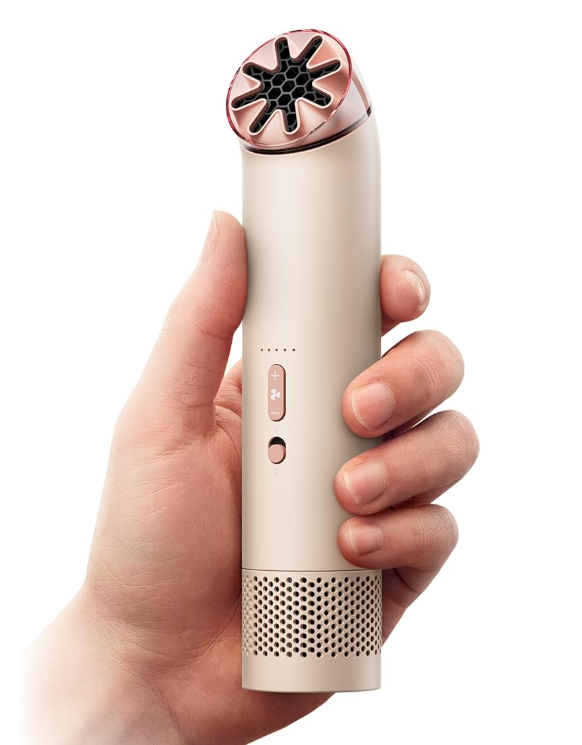

Dyson has a habit of turning simple household ideas into premium engineering products, and the HushJet Mini Cool Fan is no exception. This is their first handheld portable fan, designed to deliver high-speed cooling in a compact, bladeless form that fits in your hand, on a desk, or around your neck.
The marketing makes it feel like a mini climate system you can carry anywhere. Powerful airflow, near-silent operation, futuristic design, and Dyson-level refinement all packed into something smaller than a drink can.
On paper, it looks like a serious upgrade over typical handheld fans. But once you strip away the branding, the real question becomes whether this level of engineering actually changes the experience of staying cool in everyday situations.
Quick Take
- Compact handheld fan using Dyson’s HushJet airflow system
- Strong airflow for its size with up to 55 mph boost mode capability
- Premium design and multiple use modes (handheld, desk, wearable)
- Quietness and comfort vary depending on speed level and conditions
- Overall impression: genuinely powerful for a handheld device, but still fundamentally a personal fan with premium pricing attached
Table of Contents
- Quick Take
- What the Dyson HushJet Mini Cool Fan Is Supposed to Do
- What Stands Out in Real Use
- Where the Experience Becomes More Limited
- The Premium Price Question
- A Pattern I Keep Seeing
- Is the Dyson HushJet Mini Cool Fan Legit?
- Final Thoughts
- FAQ
What the Dyson HushJet Mini Cool Fan Is Supposed to Do
The HushJet Mini Cool Fan is built as a portable personal cooling device using a high-speed brushless motor and Dyson’s enclosed airflow system.
It offers:
- multiple speed settings
- a boost mode for stronger airflow
- up to around 6 hours of battery life depending on use
- USB-C charging
- handheld, desk, and wearable operation modes
The key idea is focused airflow rather than room cooling. Instead of trying to cool an entire space, it directs high-velocity air at the user for immediate personal relief. This is the same category Dyson has been refining for years in larger fans and air treatment devices, just scaled down into something wearable.
What Stands Out in Real Use
The most noticeable thing about this kind of device is how concentrated the airflow feels. It’s not a wide, room-filling breeze. It’s more direct, almost like a controlled stream of air aimed exactly where you point it.
At lower speeds, it’s comfortable enough for indoor use like working at a desk or commuting. At higher settings, it shifts into a much stronger cooling experience that feels closer to a traditional fan at short distance.
Battery life appears realistic in the 3–6 hour range depending on intensity, which is fairly standard for high-output portable devices of this size.
The build quality is exactly what you’d expect from Dyson: compact, dense, and engineered with a focus on portability rather than bulk cooling power.
Where the Experience Becomes More Limited
The biggest limitation is also the most obvious one: physics. A handheld fan, no matter how advanced, is still a localized cooling tool. It doesn’t lower room temperature. It doesn’t replace air conditioning. It simply moves air toward the skin.
At higher speeds, the airflow becomes more powerful, but it also becomes more noticeable in terms of sound and directional focus. That means it works best when held or positioned correctly rather than used passively. It also means effectiveness drops quickly if you’re expecting full-body or environmental cooling instead of personal airflow relief.
The Premium Price Question
This is where most Dyson products tend to divide opinion. You’re not just paying for airflow. You’re paying for:
- compact engineering
- brand design language
- battery integration
- motor performance efficiency
- portability packaging
There are cheaper handheld fans that provide basic cooling, but they don’t deliver the same level of power density or refinement in form factor.
The real question is whether that refinement matters enough in daily use to justify the price difference. For some users, especially commuters, office workers, or people in hot climates who want something portable and clean-looking, it might.
For others, it will feel like an expensive version of a very simple idea.
A Pattern I Keep Seeing
This product fits into the same broader pattern that shows up with a lot of modern “smart” or “premium mini” appliances.
I’ve seen a similar dynamic with products like the DREO Smart Fan and WORX Landroid Vision 4WD WR344.
The formula tends to look like this:
- take a simple utility product
- compress it into a high-tech form factor
- add premium branding and engineering language
- position it as a lifestyle upgrade rather than just a tool
Sometimes that results in genuinely better performance and usability. Other times, it mostly changes how the product feels rather than what it fundamentally does.
The HushJet Mini Cool sits closer to the “refined execution of a simple tool” side of that spectrum.
Is the Dyson HushJet Mini Cool Fan Legit?
Yes, this is a real, well-engineered handheld cooling device with strong airflow performance for its size category.
It does what it claims in terms of producing directional cooling and offering portable airflow across different use cases.
The main limitation is not functionality, but expectation.
It is still a personal fan, not a full cooling solution. The marketing leans heavily into innovation language, but the actual benefit is more practical: convenient, controlled airflow on demand.
Final Thoughts
The Dyson HushJet Mini Cool Fan feels like a polished version of something fundamentally simple. It delivers strong portable airflow, solid battery performance, and a level of design refinement that clearly separates it from generic handheld fans.
But once you step back from the engineering language and branding, the core experience remains what it has always been: personal cooling through directed air. The value ultimately depends on whether that refinement, portability, and build quality matter enough to justify paying for a premium interpretation of a very basic function.
FAQ
Is the Dyson HushJet Mini Cool Fan actually powerful?
Yes, it produces strong directional airflow for its size, especially in boost mode, though it is still limited to personal cooling rather than room cooling.
How long does the battery last?
Battery life varies by speed, but generally ranges from a few hours up to around six hours on lower settings.
Is it quiet?
It is relatively quiet at lower speeds, but becomes noticeably louder at higher airflow levels or boost mode.
Can it replace an air conditioner?
No. It is designed for personal cooling only and does not lower ambient room temperature.
Is it worth buying?
It depends on whether you value portability, design, and strong personal airflow over basic low-cost cooling alternatives.