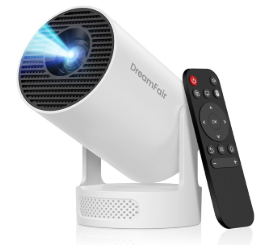

The DreamFair Mini Projector is the sort of gadget I can understand someone buying without spending weeks researching. It’s small, affordable, and advertised with features you’d normally associate with more expensive projectors. There’s 4K support, wireless connectivity, automatic image adjustment, and a rotating stand that lets you project onto a wall or ceiling. For around $40 to $50, that sounds like a convenient way to watch movies without investing in a large television.
But inexpensive projectors often look better on paper than they perform in someone’s living room. I wanted to know what DreamFair actually offers beyond its advertising, particularly whether its picture quality, construction, and built-in software make it worth buying. This review is research-based rather than a personal account of testing the projector. I’ll examine the HY300PRO model’s specifications, physical design, customer experiences, and the compromises buyers should expect.
Quick Takeaway
- Product: DreamFair HY300PRO Mini Projector.
- Price: Approximately $38–$47 in the listings examined.
- Resolution: Native 1280 × 720 pixels, despite advertising 4K video support.
- Brightness: Advertised at approximately 180–200 ANSI lumens, depending on the listing.
- Features: Rotating stand, Wi-Fi, Bluetooth, built-in apps, and automatic keystone correction.
- Customer feedback: Mixed, with praise for convenience and complaints about image quality, software, and reliability.
- Verdict: A legitimate budget projector, but one I’d approach with modest expectations and a dependable return policy.
Table of Contents
- Quick Takeaway
- DreamFair HY300PRO Specifications
- The 4K Label Makes the Picture Sound Sharper Than It Is
- The Compact Design Is Convenient, but How Well Is It Built?
- Built-In Streaming Sounds Convenient Until the Apps Stop Working
- Actual Buyers Have Reported Some Frustrating Problems
- DreamFair Isn’t the Only Projector Wearing This Design
- Pros and Cons
- Is the DreamFair Mini Projector a Scam? My Verdict
DreamFair HY300PRO Specifications
The DreamFair HY300PRO belongs to the inexpensive smart-projector category, where several models share similar designs and specifications. The following details come from the product documentation and listings I examined. Some features may vary between versions, so buyers should confirm the exact model before ordering.
| Specification | DreamFair HY300PRO |
|---|---|
| Display technology | LCD projection |
| Native resolution | 1280 × 720 (720p HD) |
| Video input support | Advertised 1080p and 4K support |
| Brightness | Approximately 180–200 ANSI lumens advertised |
| Operating system | Android-based, advertised as Android 11 |
| Wireless connectivity | Wi-Fi and Bluetooth |
| Physical adjustment | 180-degree rotating body |
| Image correction | Automatic keystone correction advertised |
| Connections | HDMI and USB on commonly listed HY300PRO configurations |
| Audio | Built-in speaker |
| Power | External power connection |
| Typical advertised price | Approximately $38–$47 |
The specifications are reasonable for a projector at this price, but I wouldn’t assume every listing uses identical internal hardware. The HY300PRO name appears across multiple brands, and sellers sometimes describe features differently. I’d check the exact unit’s manual and connector layout before relying on any advertised specification.
The 4K Label Makes the Picture Sound Sharper Than It Is
The biggest limitation of DreamFair is its native resolution. Although the projector is advertised as supporting 4K and 1080p content, its documented 1280 × 720 display can only produce a 720p image. It may accept higher-resolution video and scale it down, but it cannot reproduce the fine detail of a genuine 4K projector. That difference becomes more noticeable when the picture is enlarged, particularly with subtitles, small text, and detailed scenes. Brightness creates another limitation. At approximately 180–200 advertised ANSI lumens, DreamFair is better suited to a dark bedroom than a living room with daylight coming through the windows. A larger projected image will also look dimmer because the available light is spread across a greater area. I wouldn’t expect a convincing 100-inch home-theater experience in ordinary daytime conditions. For occasional movie nights in a dark room, however, the picture may be acceptable to someone who isn’t expecting television-level sharpness. I’ve discussed similar resolution and brightness compromises in my VOPLLS G3 Pro Projector review, where the advertised capabilities also needed to be distinguished from the projector’s actual display hardware.
The Compact Design Is Convenient, but How Well Is It Built?
The physical design is probably DreamFair’s strongest selling point. Its cylindrical body sits inside a rotating support that allows the lens to point toward a wall or ceiling without requiring a separate mounting bracket. I like that arrangement because it makes the projector easier to reposition between a bedroom, desk, and temporary viewing area. Its compact size also means it shouldn’t demand much storage space. However, convenience isn’t the same as durability. The outer construction resembles other inexpensive HY300PRO projectors, and I couldn’t find a reliable independent teardown or long-term mechanical assessment establishing the quality of its casing, rotating joint, cooling fan, or internal components. The automatic keystone feature may help correct image geometry when the projector is tilted, but it doesn’t guarantee uniform sharpness across the picture. Buyers should also pay attention to ventilation, since compact projectors still need sufficient airflow to manage heat. I wouldn’t describe DreamFair as well-built simply because its design looks practical. Its construction appears suitable for a budget portable device, but the available evidence doesn’t establish how well it will withstand prolonged use.
Built-In Streaming Sounds Convenient Until the Apps Stop Working
DreamFair is marketed as a smart projector with Android-based software, Wi-Fi, Bluetooth, and access to entertainment applications. That sounds useful because it could eliminate the need to connect a laptop or separate streaming device every time you want to watch something. However, built-in Android software doesn’t automatically mean that Netflix, Disney+, Prime Video, or other major services are officially certified to work at their full supported quality. Some inexpensive projectors use Android-based interfaces without the certification required for certain protected streaming content. The customer feedback I examined also included complaints about unreliable applications and difficulties maintaining wireless connections. Those are more than minor annoyances if the entire reason for buying a smart projector is to avoid external equipment. Personally, I’d rather use a dependable HDMI streaming device than spend time troubleshooting built-in apps, provided the projector supports the device properly. DreamFair’s software features are appealing, but I wouldn’t treat them as a substitute for verified streaming compatibility.
Actual Buyers Have Reported Some Frustrating Problems
Unlike many unfamiliar gadgets promoted through standalone sales websites, DreamFair has customer feedback that goes beyond polished advertising testimonials. One Amazon-linked review collection I examined showed an overall rating of approximately 3.9 out of 5 from 428 ratings. Positive buyers described the projector as convenient, easy to set up, and enjoyable for casual viewing. Some were satisfied with the picture considering its low price. The negative experiences tell a less encouraging story. One reviewer complained about an extremely blurry image, poor sound, repeated Wi-Fi connection attempts, and apps that failed to work properly. That customer later reported that the unit stopped turning on and described difficulty obtaining a satisfactory remedy. Other complaints involved focus and connection problems. I wouldn’t treat a handful of negative accounts as proof that every DreamFair projector is defective, especially when marketplace listings can group related product variants. Still, the complaints raise legitimate questions about quality control and after-sales support. A cheap projector that needs replacing after a short period isn’t necessarily good value, regardless of how attractive its original price looked.
DreamFair Isn’t the Only Projector Wearing This Design
I found DreamFair’s appearance and feature list closely matched other projectors sold under the HY300 and HY300PRO names. The rotating cylindrical body, integrated stand, Android-style interface, and familiar wireless features are common across this category. That suggests DreamFair is part of a broader family of inexpensive projector designs rather than an entirely original product. It doesn’t establish that all versions come from the same factory or use identical components, but it does make the branding less important than the actual hardware and seller. In one projector discussion, DreamFair appeared at approximately $37.69 alongside similarly priced HY300-style alternatives. I’d compare the native resolution, seller reputation, warranty terms, and verified owner feedback rather than assume that one brand offers better quality because its listing looks more professional. I’ve also discussed the practical compromises of inexpensive projection equipment in my Mini Projector Review. The lesson I take from this category is that a low purchase price can be attractive, but dependable hardware and support are what determine whether the purchase remains worthwhile.
Pros and Cons
Pros
- Affordable entry point for casual home projection.
- Rotating design makes wall and ceiling viewing convenient.
- Compact enough to move between rooms.
- Built-in wireless features reduce the need for extra equipment when they work properly.
Cons
- Native 720p resolution limits image detail.
- Low advertised brightness restricts use in well-lit rooms.
- Reports of unreliable apps, connectivity problems, and premature failure.
- Uncertain long-term durability and inconsistent specifications across listings.
Is the DreamFair Mini Projector a Scam? My Verdict
I wouldn’t call the DreamFair Mini Projector a scam. It’s an identifiable budget projector with published specifications and customer accounts showing that people have received and used it. However, the advertising can create unrealistic expectations, particularly when 4K support is presented prominently without making the native 720p resolution equally clear. At around $40, I can see its appeal as an occasional bedroom projector for someone who wants a simple, inexpensive way to watch movies in a dark room. I wouldn’t choose it as a primary television replacement or expect the performance of a proper home-theater projector. If I were buying one, I’d choose a retailer with a clear return policy and dependable purchase protection rather than an unfamiliar seller offering the lowest possible price. DreamFair may be inexpensive enough to experiment with, but its limitations and mixed reliability reports prevent me from recommending it without reservations.