
Can a small device that shines red light into your ear really quiet the ringing that’s been driving you crazy for years?
That’s the question that pulled me into Somnial NeuroTone. Tinnitus is different from most health problems. If you’ve never experienced it, it’s hard to understand how exhausting it can become. The constant ringing, buzzing, or hissing can affect sleep, concentration, mood, and overall quality of life. So when a device appears claiming it can target the problem itself instead of simply helping you cope with it, people naturally pay attention. The problem is that tinnitus has become a magnet for products that promise more than they can realistically deliver.
Quick Take
- Somnial NeuroTone is marketed as a tinnitus relief device using red light therapy and sound-based neuromodulation
- The research areas it references are real, but the science is still developing
- The biggest concern is how confidently the marketing presents a solution for a condition that still has no universally effective treatment
- It looks more like a device built around promising research than a proven breakthrough
Table of Contents
- Quick Take
- What Somnial Wants You to Believe
- Where My Skepticism Started
- What Owning This Might Actually Look Like
- What I Couldn’t Find
- A Pattern I Keep Seeing
- So, Is Somnial Actually Legit?
- My Final Take
- FAQ
What Somnial Wants You to Believe
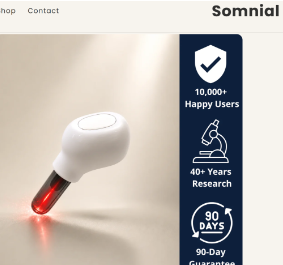
The sales pitch is fairly straightforward. Somnial NeuroTone claims to combine red light therapy with neuromodulation techniques to help reduce the perception of tinnitus. The idea is that stimulating the auditory system in specific ways may help calm the abnormal signaling associated with ringing in the ears. That sounds impressive. But what caught my attention wasn’t the technology. It was how the technology was being presented. Because there are really two separate conversations happening here.
The first is the science. Researchers have spent years studying neuromodulation, sound therapy, and various forms of stimulation as possible tinnitus treatments. That’s real.
The second is the marketing. That’s where things become much less clear. Reading through the promotional material, you get the impression that the solution is already here and that the only thing standing between you and relief is buying the device. That’s a much stronger claim than the current evidence supports.
Where My Skepticism Started
The moment I started looking through the product claims, I noticed something I’ve seen many times before in the health gadget space. The marketing isn’t really selling the device. It’s selling relief. More specifically, it’s selling relief to people who are tired, frustrated, and running out of options.
Tinnitus sufferers often spend years searching for answers. Many have already tried supplements, white noise machines, hearing aids, apps, therapy, and countless other products.
That makes this audience especially vulnerable to phrases like:
“Finally get your life back.”
“Target the root cause.”
“Experience real relief.”
The problem is that tinnitus is notoriously unpredictable. Some people improve. Some don’t. Some experience fluctuations for reasons that aren’t fully understood. When a company starts sounding more certain than the condition itself, that’s usually where my skepticism starts.
What Owning This Might Actually Look Like
One thing I kept thinking about while researching Somnial NeuroTone was what happens after the excitement of buying it wears off. Let’s say you use it exactly as instructed. A week passes. Then two. Then a month. How do you actually measure success? That’s one of the unique challenges with tinnitus products.
If you buy a posture brace, you can see whether it fits. If you buy a glucose monitor, you can compare readings. With tinnitus, the experience is far more subjective. Some days the ringing is worse. Some days it’s quieter. Sometimes stress affects it. Sometimes sleep affects it. Sometimes there seems to be no obvious reason at all.
That makes it difficult for users to know whether the device is genuinely helping, whether symptoms would have changed anyway, or whether they’re simply becoming more aware of fluctuations that were already happening.
I suspect that’s why experiences with products like this tend to vary so dramatically from person to person.
What I Couldn’t Find
One thing that gave me pause during my research was the lack of independent user discussion around Somnial NeuroTone itself. Most of the positive experiences I found came from the company’s own website. That’s not unusual for a newer product, but it does make it harder to separate customer satisfaction from marketing.
What I didn’t find were large numbers of discussions on Reddit, tinnitus forums, or independent review communities where people were documenting their experiences months after buying the device. For a product making such ambitious claims about tinnitus relief, I’d expect a stronger trail of real-world user feedback by now.
That doesn’t automatically mean the device doesn’t work. It simply means the public evidence currently feels much thinner than the confidence of the marketing.
A Pattern I Keep Seeing
Somnial NeuroTone reminds me of several other products I’ve reviewed, including Pryxo Glucose Monitor and Zenvelle Align Shoulder Brace.
Different products. Same playbook. Find a problem that frustrates people every day. Offer a simpler alternative to existing solutions. Wrap it in scientific language. Use testimonials heavily. Present the product as the answer people have been waiting for.
The interesting thing is that the underlying idea is usually not completely fake. There’s often some real science somewhere in the background. The marketing just takes that science and stretches it much further than the evidence can comfortably support.
That’s exactly what I kept running into with Somnial.
So, Is Somnial Actually Legit?
I don’t think Somnial NeuroTone falls into the category of products that are obviously fake. The concepts it references, neuromodulation, auditory stimulation, and photobiomodulation, are all legitimate areas of research.
What I couldn’t find was convincing evidence that this specific device has reached the level of certainty implied throughout the marketing. That’s an important distinction. A promising idea is not the same thing as a proven solution. For someone dealing with tinnitus, that difference matters a lot.
My Final Take
After researching Somnial NeuroTone, I kept coming back to the same conclusion. The device itself isn’t what concerns me most. It’s the expectations.
If someone buys this believing they’ve discovered a guaranteed answer to their tinnitus, there’s a good chance they’ll be disappointed.
If someone views it as an experimental wellness device based on emerging research, the expectations become much more realistic.
Tinnitus is one of the most frustrating conditions people can live with. That’s exactly why products in this space deserve extra scrutiny.The issue isn’t that the science is fake. It’s that the marketing often sounds like the science is settled when it clearly isn’t.
FAQ
Does Somnial NeuroTone cure tinnitus?
No device currently offers a universally accepted cure for tinnitus.
Is the science behind neuromodulation real?
Yes. Neuromodulation is a legitimate area of tinnitus research, although results vary and research is still ongoing.
Will Somnial NeuroTone work for everyone?
Highly unlikely. Tinnitus itself varies significantly between individuals, which is one reason treatment outcomes are often inconsistent.
Is Somnial NeuroTone a scam?
It appears to be a real product. The bigger question is whether its marketing creates expectations that current research cannot reliably support.