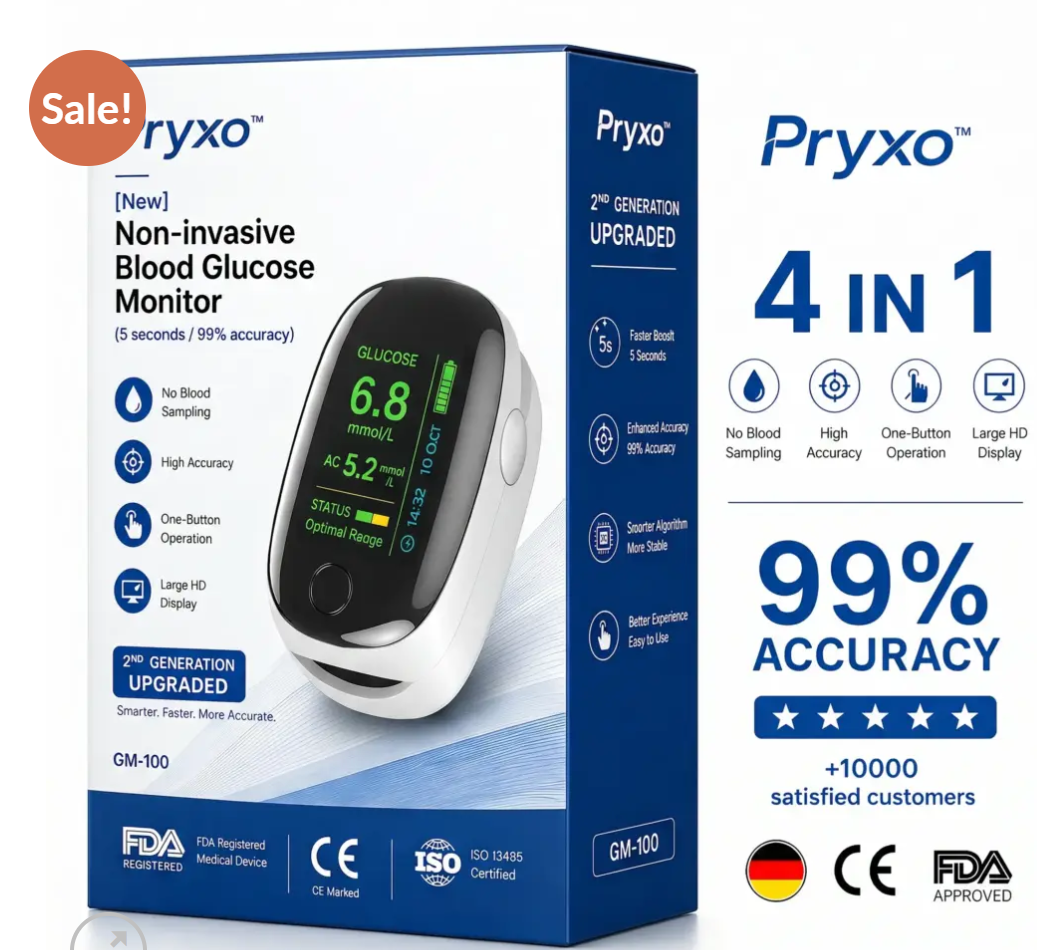

“Can a finger clip really measure blood sugar without a drop of blood, or is this just another viral health gadget pushing impossible claims?”
That’s the first thing I kept circling back to with the Pryxo Glucose Monitor because the promise sounds huge, but the setup feels familiar.
Quick Take
- Marketed as a non-invasive glucose monitor using light-based sensing
- Core idea of glucose tracking is real, but this level of consumer “no blood needed” accuracy is not proven in mainstream medical tech
- Biggest concern is aggressive accuracy and “replacement for finger pricks” messaging
- Feels more like a general wellness sensor than a medically reliable glucose device
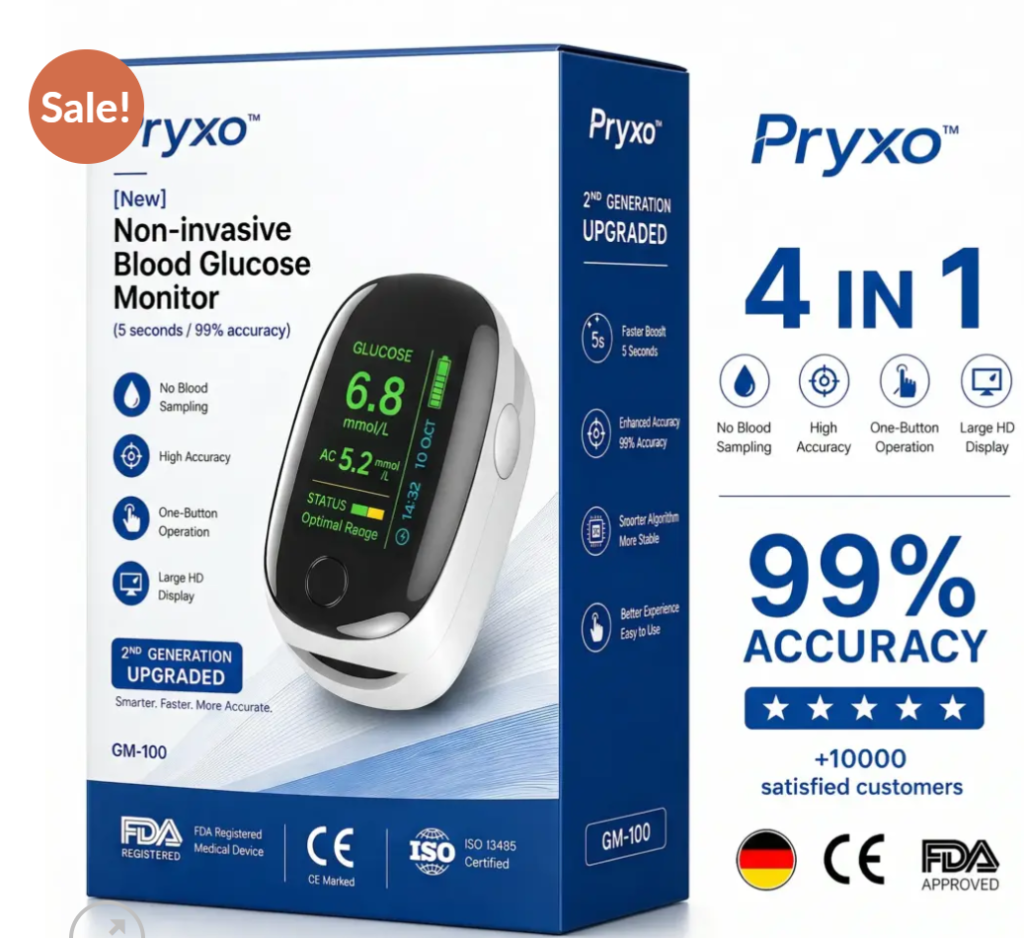
Table of Contents
- Quick Take
- What the Pryxo Glucose Monitor Is Supposed to Do
- The Main Problem / Hidden Concern
- Build Quality / Real-World Ownership
- A Pattern I Keep Seeing
- Is It Legit?
- Final Thoughts
- FAQ
What the Pryxo Glucose Monitor Is Supposed to Do
Pryxo is presented as a finger-clip device that estimates blood glucose levels using optical sensors instead of blood samples.
On the surface, the pitch is simple:
no needles, no strips, just clip it on and get instant readings.
The underlying concept being referenced here is real in a very general sense. Light-based sensors exist in medicine and are used for things like oxygen monitoring. But glucose is a completely different level of complexity when it comes to accuracy through skin and circulation variation.
And that’s where the marketing starts stretching things. Because what’s being sold is not just “a helper device”, it’s positioned like a replacement for traditional glucose testing. That’s a big leap.
The Main Problem / Hidden Concern
The issue here isn’t that the device exists. It’s how far the claims go compared to what similar technology can reliably do.
The marketing usually pushes ideas like:
- “medical-grade accuracy”
- “fully replaces finger-prick tests”
- “instant precise glucose readings”
- “no calibration needed”
That combination is where skepticism naturally kicks in. In real-world health monitoring, glucose accuracy is extremely sensitive. Even small deviations matter. So when a product implies it can fully replace established testing methods without clear clinical transparency, that becomes the central concern.
Another issue is expectation shaping. The product is framed less like a supportive tracker and more like a standalone solution, which is where most of these health gadgets tend to overreach.
Build Quality / Real-World Ownership
Looking at how devices in this category are usually built, Pryxo appears to follow a familiar pattern:
- generic finger-clip design similar to basic pulse oximeters
- sensor-driven app interpretation instead of medically validated glucose hardware
- unclear calibration process
- limited transparency on long-term accuracy consistency
And this is where ownership reality often diverges from marketing. Because even if the device “works” in a basic sense (it turns on, shows numbers, syncs to an app), the real question becomes: does it stay accurate in real-life conditions over time?
Things like:
- temperature changes
- circulation differences
- skin variation
- movement during readings
all affect optical sensors heavily. That’s usually where devices in this category start feeling inconsistent rather than dependable.
A Pattern I Keep Seeing
This sits in the same pattern I’ve seen with products like Zenvelle Align Shoulder Brace, Skolayvita Dentures, and similar health-focused gadgets.
Same structure every time:
- take a real medical concern (pain, posture, glucose, aging)
- simplify the science into a single mechanism
- promise removal of traditional “difficulty” (needles, effort, clinic visits)
- position it as a full replacement rather than a support tool
- rely heavily on emotional relief messaging
With Pryxo, the emotional hook is convenience + fear relief:
no more needles, no more hassle, just “easy monitoring.” That’s usually where expectation starts running ahead of reality.
Is It Legit?
The concept of glucose monitoring is absolutely real and medically critical. But the real question here is whether Pryxo delivers clinically reliable accuracy at the level it implies in its marketing.
Based on how these devices are typically positioned:
- it likely functions as a general wellness reading tool
- it may show trends, but not medically dependable glucose values
- it does not convincingly replace established medical glucose testing methods
So the gap here is not existence… it’s reliability vs promise.
Final Thoughts
Pryxo sits in that familiar gray zone where the device itself is real, but the marketing story does most of the heavy lifting. The appeal is obvious. A painless way to track glucose would be a major breakthrough.
But that’s exactly why this category gets pushed so aggressively online. It targets a very real health anxiety with a very simplified solution.
The issue isn’t that glucose monitoring is unnecessary or fake. It’s that the version being sold here feels significantly more advanced than what the underlying consumer technology can reliably support.
FAQ
Does Pryxo really measure blood sugar without blood?
It may provide readings through optical sensing, but accuracy compared to medical glucose testing is not clearly validated.
Can it replace finger-prick tests?
There is no strong evidence that consumer non-invasive devices can fully replace traditional glucose testing methods.
Is it safe to rely on?
For medical decisions, established glucose testing methods are still the reliable standard.
Is it a scam?
It appears to be a real device category, but the concern is exaggerated marketing versus proven clinical performance.