
There’s something appealing about having the games you grew up playing in one small console. No searching for old cartridges, connecting outdated gaming systems to a television, or spending a fortune collecting games you already enjoyed years ago. That’s the experience Retrovi Max promises, with a portable gaming console advertised for around $65 and a library of classic titles ready to play. But the more I looked into it, the more interested I became in what buyers are actually paying for. Retro gaming handhelds are everywhere now, and many look remarkably similar despite being sold under different brand names. Some are decent budget devices, while others are little more than inexpensive hardware dressed up with attractive advertising. Retrovi Max appears to fall into this crowded market, and its seller doesn’t clearly establish that the console is an original design. That doesn’t automatically make it a bad purchase, but it raises an important question: does Retrovi Max offer anything worth paying extra for, or could buyers get essentially the same gaming experience elsewhere for less?
Quick Takeaways
- Product: Retrovi Max portable retro gaming console
- Seller: Retrovi Store, operating through Retrovi.shop
- Advertised starting price: Approximately $65.37
- Storage options: 64GB and 128GB
- Purpose: Playing classic video games through emulation
- Main concern: Unclear original hardware identity and limited independently verified performance information
- Website trust: Public contact information is available, but the seller’s track record is not firmly established
- Returns: A conditional 30-day return policy, with buyers generally paying shipping for change-of-mind returns
- Verdict: Not a proven scam, but I wouldn’t recommend buying it without confirming the exact hardware, included games, and after-sales support.
Table of Contents
- Quick Takeaways
- What Exactly Is the Retrovi Max?
- Thousands of Games Don’t Guarantee a Good Gaming Experience
- Retrovi Max and Retrovi Max 2 Are Different Consoles
- The Retrovi Max Price Isn’t Necessarily a Bargain
- Is Retrovi.shop a Trustworthy Store?
- Returns and Warranty Terms Could Make a Cheap Console Expensive
- Conclusion: Is the Retrovi Max Retro Gaming Console a Scam or Legit?
What Exactly Is the Retrovi Max?
Retrovi Max is a portable gaming handheld sold by Retrovi Store, an online retailer that markets retro consoles and accessories. The original Max is listed in different colours with 64GB and 128GB storage options, and its design follows the familiar layout of budget handheld gaming devices. Rather than using physical game cartridges, consoles in this category rely on emulation software to run games originally developed for older systems. Emulation essentially allows one device to imitate the hardware of another, making it possible to play classic titles without owning the original console. It’s a useful technology, and there are plenty of good handhelds built around it. What I couldn’t establish, however, is the original manufacturer’s identity for this particular Retrovi Max. The retailer’s legal information acknowledges that its trading name doesn’t necessarily identify the company that manufactured the hardware. That’s worth knowing because a familiar-looking device sold under a new brand name isn’t necessarily a newly developed console. Retailers can purchase existing hardware, package it differently, and sell it under their own branding. There’s nothing inherently fraudulent about that arrangement, provided buyers aren’t misled about what they’re receiving. My concern is that Retrovi doesn’t provide enough model-specific technical information to make an informed comparison with other handhelds. Without a confirmed processor, memory configuration, screen specification, and original hardware designation, it’s difficult to determine whether the asking price reflects better equipment or simply a retailer’s markup.
Thousands of Games Don’t Guarantee a Good Gaming Experience
A large collection of classic games sounds impressive, but the number of titles included tells me surprisingly little about how enjoyable the console will be. Retrovi’s marketing leans heavily on nostalgia and the convenience of having older games available in one place. The problem is that running a game and running it properly are two different things. Early Nintendo and Sega games are generally less demanding than titles developed for later systems such as the original PlayStation or PlayStation Portable. More demanding games can struggle on inexpensive hardware, producing slow movement, distorted audio, delayed button responses, or frequent interruptions. Whether that happens on Retrovi Max depends on its actual processor, software, and emulator settings, none of which I could verify sufficiently for the original model. There’s also the question of what’s included in the advertised library. A collection containing thousands of files may include duplicate games, different regional releases, unfamiliar titles, and games that don’t work as expected. Increasing the storage from 64GB to 128GB provides room for more files, but it doesn’t make the processor faster or improve compatibility. I would also want to know whether games save correctly, whether menus are available in English, and how easily users can find the titles they actually want. Another issue rarely explained in these advertisements is game licensing. Emulation software can be legitimate, but that doesn’t automatically mean a seller has permission to distribute every copyrighted game included on a memory card. Retrovi hasn’t provided enough publicly verifiable information for me to establish the licensing status of its advertised library. For a console whose main attraction is convenience, those unanswered questions are more important than a huge game count.
Retrovi Max and Retrovi Max 2 Are Different Consoles
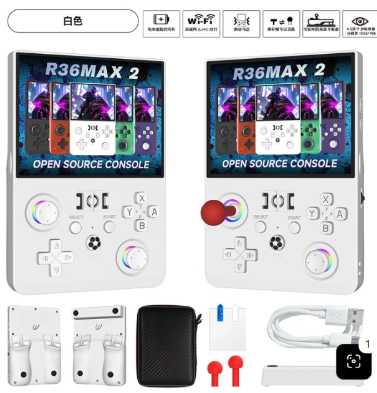
One detail that could easily confuse buyers is that Retrovi Store sells both the original Retrovi Max and a newer model called the Retrovi Max 2. They aren’t interchangeable products, and specifications advertised for one shouldn’t automatically be attributed to the other. The original Max starts at approximately $65.37, while the Max 2 is advertised for around $79. The newer model’s listing describes a 4.5-inch IPS display with a claimed resolution of 1024 × 768, dual analogue sticks, Wi-Fi connectivity, and microSD storage. Its promotional imagery also identifies it as an R36MAX2, which provides a useful clue about the hardware being sold. That branding suggests buyers should compare the device with other R36MAX2 listings before assuming Retrovi has developed something exclusive. However, it doesn’t establish that every console with a similar name contains identical components or accessories. I also found a separate review attributing an RK3326 processor, 1GB of RAM, and a 4,000mAh battery to the Max 2, but those figures shouldn’t be transferred to the original Retrovi Max without verification. This distinction matters because online reviews sometimes discuss an entire product range as though every version has the same specifications. A buyer could end up paying for the original Max while expecting features shown in demonstrations of the Max 2. Before ordering either model, I’d want the seller to identify the exact hardware and explain what distinguishes it from other similarly designed handhelds. If two devices use the same components and software, the better purchase may simply be the one offering the most reliable support at the lowest total price.
The Retrovi Max Price Isn’t Necessarily a Bargain
The original Retrovi Max is advertised at $65.37 against a crossed-out price of $105, making the offer appear substantially discounted. That might encourage someone to buy quickly, particularly if they’re unfamiliar with the prices of retro gaming handhelds. But a discount only represents genuine savings when the higher price reflects a meaningful previous selling price or established market value. I couldn’t independently verify that $105 was the normal selling price for the exact console, so I wouldn’t treat the difference as money saved. The more useful comparison is what similar handhelds cost from other retailers. Devices in the R36S and related budget retro gaming categories are widely sold under different names and configurations, sometimes with substantial differences in pricing despite looking nearly identical. That doesn’t prove Retrovi Max is the same as any particular model, but it makes hardware identification especially important. A higher retail price can be justified by better quality control, dependable memory cards, a properly configured operating system, useful accessories, or reliable customer service. What I haven’t seen is enough evidence showing that Retrovi consistently provides those advantages. The final checkout price also matters. Choosing a larger storage option, adding accessories, or paying international delivery charges can change the value considerably. If I were shopping for a retro handheld at this price, I’d compare the exact console, not the advertised percentage discount. Paying $65 for a well-supported device could be reasonable. Paying the same amount for unidentified hardware with uncertain performance is much harder to justify.
Is Retrovi.shop a Trustworthy Store?
Retrovi Store provides more contact information than many anonymous online shops. Its website identifies Colombia as its country of operation and publishes an email address, WhatsApp number, and customer service hours. It also describes a process for handling complaints and tracking support requests. Those are useful details because buyers at least have identifiable channels through which to contact the retailer. However, publishing contact information doesn’t establish that the business consistently delivers orders or resolves disputes satisfactorily. I couldn’t independently confirm a registered corporate identity or a substantial history of successful transactions. The website features customer testimonials and claims of positive buyer experiences, but testimonials controlled by the seller aren’t as persuasive as detailed reviews published independently. I also found that Scam Detector assigns Retrovi.shop a trust score of 16.8 out of 100, categorising it as high-risk. I wouldn’t use that automated rating alone to declare the business fraudulent because such systems can produce questionable results, especially when assessing smaller retailers. Still, it adds another reason to examine the purchase carefully. What I’d like to see is a stronger record of independently documented deliveries, honest product demonstrations, and customers describing how the store handled problems after purchase. Without that evidence, I can’t confidently recommend Retrovi.shop as a dependable place to buy electronics. It may be a functioning reseller, but its public information doesn’t establish the level of reassurance I’d expect from a retailer asking customers to purchase unfamiliar hardware internationally.
Returns and Warranty Terms Could Make a Cheap Console Expensive
Retrovi Store advertises a 30-day return period, which sounds reassuring until you read the conditions. According to its published policy, customers returning an item because they changed their mind are generally responsible for return shipping. The console must also be complete and in acceptable condition, with its original accessories and packaging. This matters because Retrovi operates from Colombia and sells internationally, meaning a buyer outside the country could face substantial postage costs if the device isn’t what they expected. The policy treats defective, damaged, incomplete, or incorrect orders differently, stating that the retailer will arrange an appropriate solution without charging necessary return costs when the problem is attributable to the product, shipping, or seller. However, customers may need to provide photographs or videos, and the company can choose between technical assistance, repair, replacement, or a refund depending on the circumstances. I also noticed that the advertised 90-day warranty in the general policy specifically refers to the Champions Edition console. I wouldn’t assume the same coverage automatically applies to every Retrovi Max variant without written confirmation. Another detail worth knowing is that the policy excludes certain problems caused by modifying software, formatting storage, or incorrectly installing operating systems. That’s relevant because people who buy retro handhelds often experiment with firmware and memory cards. The retailer also instructs customers to obtain an authorised return address before sending anything back. For a product costing around $65, an overseas return could become an expensive and time-consuming exercise. I’d want the return destination and warranty coverage confirmed before paying, rather than discovering those details after something goes wrong.
Conclusion: Is the Retrovi Max Retro Gaming Console a Scam or Legit?
I wouldn’t call Retrovi Max a confirmed scam because I haven’t found sufficient evidence that the retailer is systematically taking payments without delivering products. The more convincing concern is whether buyers are getting good value from a handheld whose original hardware and real-world performance aren’t clearly established. Retrovi is selling into a market already filled with inexpensive retro consoles, and I haven’t seen anything that makes its original Max stand out as a particularly compelling purchase. The nostalgia is understandable, and a basic handheld can be perfectly enjoyable for someone who mainly wants to revisit older games. But I’d rather buy a device with identifiable components, independent gameplay demonstrations, and a dependable retailer behind it. The original Retrovi Max might provide an enjoyable experience, but there’s too much uncertainty for me to recommend it confidently at its advertised price. If you’re considering buying one, ask for the exact hardware specifications and compare them with established alternatives before ordering. My recommendation is to hold off unless the seller can provide convincing answers. You don’t need an expensive console to enjoy classic games, but you should know what you’re paying for.
Read Also >>> QIFOR Automotive Headlight Restoration Kit Review: I Tried It and Wasn’t Impressed