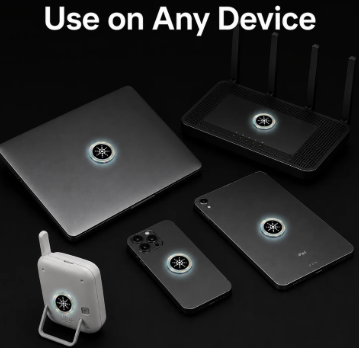

A small sticker attached to the back of a mobile phone sounds like a convenient way to reduce exposure to electromagnetic fields (EMFs). That’s essentially what QShield is selling. The company claims its EMF Protection Chip absorbs and neutralizes electromagnetic radiation from phones, tablets, laptops and other electronic devices. It also associates the product with better sleep, clearer thinking, reduced stress and improved energy. Those are appealing promises, particularly for people who spend several hours a day around electronic devices. But I wanted to know what actually makes this little chip work and, more importantly, whether the research presented on its website supports what the company is promising. One scientific paper caught my attention, although it turned out to be rather different from what the product page suggests.
Table of Contents
- What Is the QShield EMF Protection Chip?
- The Scientific Study QShield Uses to Support Its Claims
- The Study Doesn’t Prove QShield Reduces Radiation Exposure
- QShield’s Health Claims Go Further Than Its Evidence
- What Is Inside the QShield Chip?
- QShield Customer Reviews and Company Information
- QShield Pricing and Refund Policy
- A Pattern I Keep Seeing With Consumer Technology
- What Can You Do Instead of Buying an EMF Protection Chip?
- Is QShield EMF Protection Chip Worth Buying?
- Frequently Asked Questions
- Bottom Line
What Is the QShield EMF Protection Chip?
QShield is an adhesive accessory designed to attach to electronic devices or their protective cases. According to the manufacturer, it uses advanced nanomaterials to absorb and neutralize electromagnetic radiation without interfering with normal device operation. It’s advertised for smartphones, tablets, laptops, and other electronics, making it appealing to people who want additional protection without changing their everyday habits. The company also associates the chip with better sleep, reduced fatigue, improved concentration, and less brain fog, although these health benefits require evidence beyond the manufacturer’s descriptions.
The Scientific Study QShield Uses to Support Its Claims
The first thing I checked was the scientific paper linked on QShield’s product page under the heading “Evaluated By The National Institute of Health.” The paper, published in Frontiers in Neuroscience in 2018, is titled “Mobile Phone Chips Reduce Increases in EEG Brain Activity Induced by Mobile Phone-Emitted Electromagnetic Fields.” Researchers recruited 30 healthy participants and compared three iPhone 5S devices: one fitted with a chip, another with a placebo chip, and a third without a chip. They measured brain activity using electroencephalography (EEG) and reported differences between the three conditions, alongside differences in attention-test performance. However, the chip tested was manufactured by Gabriel-Tech, specifically the GDM40 15 02 60 model. The researchers did not identify QShield as the product being investigated. Research involving one manufacturer’s chip cannot automatically establish that another company’s product works similarly. QShield would need to demonstrate that its own materials, construction, and performance are comparable. Also, a paper being available through the National Library of Medicine’s PubMed Central repository does not mean the National Institutes of Health tested or endorsed QShield.
The Study Doesn’t Prove QShield Reduces Radiation Exposure
The 2018 paper is relevant to research on mobile phone chips, but it doesn’t establish that QShield reduces radiofrequency exposure. It examined EEG changes in a relatively small group under controlled laboratory conditions, not the performance of QShield itself. It also didn’t establish that the product improves sleep, prevents headaches, reduces fatigue, or protects against long-term health problems. I couldn’t find independent laboratory testing demonstrating how much radiofrequency exposure QShield actually reduces. If a company claims its product absorbs or neutralizes radiation, it should provide measurable results, explain the testing conditions, and make those results independently verifiable. Changes in EEG measurements are not the same as proof that an adhesive chip reduces the radiofrequency energy absorbed by the body.
QShield’s Health Claims Go Further Than Its Evidence
QShield’s marketing associates everyday EMF exposure with brain fog, chronic fatigue, sleep disturbances, hormonal imbalances, reduced fertility, and childhood developmental concerns. It then presents the chip as a convenient way to reduce these risks. However, the existence of electromagnetic fields and radiofrequency emissions doesn’t mean all these health problems have been established as consequences of ordinary mobile phone use. The US Food and Drug Administration says the weight of scientific evidence has not linked radiofrequency radiation from cell phones with health problems, while the Centers for Disease Control and Prevention notes that research into possible long-term effects is ongoing. QShield doesn’t make these distinctions particularly clear, and I couldn’t find product-specific clinical research supporting its promises of improved wellbeing.
What Is Inside the QShield Chip?
QShield repeatedly refers to advanced nanomaterials and nanotechnology, but its product information doesn’t provide a sufficiently detailed breakdown of the materials used. This makes it difficult to assess the technology independently. Nanotechnology is a broad term covering materials with different physical and electromagnetic properties, so simply using the term doesn’t explain how a product works. The company also doesn’t adequately explain how such a small adhesive chip supposedly neutralizes radiation across phones, laptops, and wireless routers. I would expect technical specifications and independent test results rather than relying entirely on the manufacturer’s explanation.
QShield Customer Reviews and Company Information
The website displays 15,277 customer reviews, alongside testimonials from people claiming improvements in sleep, concentration, and general wellbeing. Some also describe attaching the chips to children’s tablets and household electronics. However, I couldn’t independently verify the displayed review count or establish that the testimonials represent authenticated customer experiences. The website identifies the seller as Q Shield and provides hello@tryqshield.com for customer support, but I couldn’t establish a clearly identified legal manufacturer or verifiable business address from the information presented. The store operates on Shopify, which is a common ecommerce platform and not suspicious by itself. My concern is the limited information about the business responsible for manufacturing and testing a product making health-related claims.
QShield Pricing and Refund Policy
During my review, the product page displayed a single-chip option for $19.99 and a three-plus-three-free bundle for $87. The homepage also showed a different promotional price, so customers should check the actual checkout total before ordering. QShield advertises a 90-day money-back guarantee, but I would read the complete conditions carefully, particularly the return requirements, shipping costs, and refund procedure. A guarantee may offer some reassurance, but it doesn’t demonstrate that the product works.
A Pattern I Keep Seeing With Consumer Technology
I have come across similar marketing issues when reviewing electronic gadgets. In my Govee Hygrometer review, I looked beyond the advertised features to examine what the device actually offers, including its tracking capabilities, app functionality, and limitations. QShield deserves the same scrutiny. Impressive technical language and promises are not enough; manufacturers should provide clear specifications and evidence that their products deliver what they advertise.
What Can You Do Instead of Buying an EMF Protection Chip?
If you want to reduce radiofrequency exposure, the National Cancer Institute explains that exposure decreases rapidly as the distance between a phone and the body increases. Practical measures include using speakerphone or a hands-free headset, avoiding unnecessary direct contact between your phone and body, making shorter calls, and avoiding lengthy calls when your phone has a weak signal because it may increase transmission power. Texting instead of making lengthy calls is another option. These measures have a more straightforward physical basis than relying on an adhesive chip whose protective performance hasn’t been independently established.
Is QShield EMF Protection Chip Worth Buying?
I wouldn’t recommend purchasing QShield based on the available evidence. The main problem isn’t its size or the scientific terminology in its marketing; it’s the lack of convincing product-specific evidence supporting its radiation-reduction and health claims. The 2018 study is a genuine scientific publication, but it investigated a Gabriel-Tech chip, not QShield. Until the manufacturer provides independently verifiable testing of the actual product, customers have little reason to pay for protection that hasn’t been demonstrated.
Frequently Asked Questions
Does QShield actually block EMF radiation?
The manufacturer claims it absorbs and neutralizes electromagnetic radiation, but I couldn’t establish independent laboratory evidence showing how much radiofrequency exposure the chip reduces.
Has QShield been tested by the National Institutes of Health?
I couldn’t verify that. The website links to a 2018 paper available through PubMed Central, but the study investigated a Gabriel-Tech chip, not QShield. Its availability through an NIH-supported repository does not mean the NIH tested or endorsed this product.
Can QShield improve sleep and concentration?
The company advertises these benefits, but I couldn’t find product-specific clinical evidence establishing that QShield improves sleep, concentration, or energy levels.
Can I use QShield on my laptop and Wi-Fi router?
The manufacturer says the chip works with phones, tablets, laptops, and other electronics. However, independent evidence confirming its effectiveness across these devices was not available.
Is QShield a scam?
I don’t have sufficient evidence to label the product or seller a confirmed scam. However, its radiation-protection and health claims are not adequately supported by the research presented on its website, so I would approach the purchase with caution.
Bottom Line
QShield is marketed as a simple solution to concerns about electromagnetic radiation, but the evidence presented by its manufacturer doesn’t establish that this particular chip provides the advertised protection. The scientific study linked on its website investigated a different product, and QShield provides no convincing independent testing of its own. Until that changes, I don’t think consumers have a good reason to spend money on this chip.