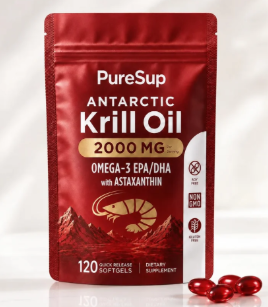

PureSup Krill Oil has quite an attractive sales pitch. It promises support for heart health, joints and eye comfort, and the company has recently put particular emphasis on helping people with dry, irritated eyes. It also advertises 2,000mg of Antarctic krill oil per serving, which sounds like a generous amount for anyone shopping for an omega-3 supplement. But I became less impressed when I started checking the actual formula against those promises. The product contains considerably less EPA and DHA than its headline figure might suggest, and I found conflicting dosage instructions on the company’s own website. Neither issue automatically makes PureSup a bad product, but together they raise questions that I think buyers should consider before spending their money.
Table of Contents
- What Is PureSup Antarctic Krill Oil?
- What I Found in PureSup’s Supplement Facts
- Does PureSup Have Enough Evidence Behind Its Dry-Eye Claims?
- Is Krill Oil Actually Better Than Fish Oil?
- Why Are PureSup’s Dosage Instructions Different?
- What Do PureSup Customers Say?
- How Much Does PureSup Krill Oil Cost?
- PureSup Krill Oil Red Flags
- Is PureSup Krill Oil Safe?
- My Verdict: Would I Buy PureSup Krill Oil?
What Is PureSup Antarctic Krill Oil?
PureSup Antarctic Krill Oil is a dietary supplement made from krill, small crustaceans harvested from the Southern Ocean. Krill naturally contain omega-3 fatty acids, including EPA and DHA, as well as phospholipids and astaxanthin, an antioxidant responsible for their reddish colour. PureSup uses these features to distinguish its product from conventional fish oil, particularly by promoting the phospholipid form of its omega-3s. The company also markets the supplement for several health concerns, including dry eyes, heart health, healthy triglycerides and joint comfort. These are familiar reasons people turn to omega-3 supplements, but I don’t think the presence of krill oil alone is enough to establish that a product will deliver all these benefits. I wanted to see whether PureSup’s actual formula gives buyers a good reason to believe its promises.
What I Found in PureSup’s Supplement Facts
The 2,000mg figure is probably the first thing many shoppers will notice. However, it refers to the amount of krill oil, not the amount of omega-3 fatty acids. PureSup’s supplement facts list 180mg of total omega-3s in two softgels, including 80mg of EPA and 40mg of DHA. The company recommends taking four softgels daily, but even then, the combined EPA and DHA content remains fairly modest. This is the detail I think deserves more attention than the headline number. Someone comparing PureSup with another omega-3 supplement could easily assume that 2,000mg means a particularly concentrated dose, when it doesn’t.
The formula also contains astaxanthin, which is a natural component of krill oil and an interesting addition. But I wouldn’t make too much of it. Antioxidants are often given impressive roles in supplement advertising, yet their presence doesn’t automatically mean the finished product will produce noticeable improvements in eye health or general wellbeing. PureSup has some appealing ingredients, but I would rather see the company make the actual nutritional value of its formula clearer instead of leaning so heavily on the total oil content.
Does PureSup Have Enough Evidence Behind Its Dry-Eye Claims?
This is the claim I would be most careful about if I were considering the product. PureSup explains that omega-3s may support the oily layer of the tear film, which helps keep tears from evaporating too quickly. It also advertises improvements in gritty, burning and uncomfortable eyes. The explanation sounds reasonable, and researchers have investigated omega-3 supplements for dry-eye disease. However, the results aren’t as straightforward as the marketing might suggest.
One clinical trial involving 60 people with mild to moderate dry eyes investigated krill oil over several months and reported improvements in some symptoms and tear-film measurements. That’s encouraging, but the participants received considerably more EPA and DHA than PureSup provides at its recommended daily intake. There is also the much larger DREAM study, which found that omega-3 supplementation did not improve dry-eye symptoms more than a placebo. So, while I wouldn’t say omega-3s have no possible role in eye health, I don’t think PureSup has enough evidence to make its dry-eye promises sound like an established result. The fact that a study investigated krill oil doesn’t mean this particular product, with its own formulation and dosage, has been proven to work.
Is Krill Oil Actually Better Than Fish Oil?
PureSup’s emphasis on phospholipids is not entirely marketing nonsense. Krill oil contains omega-3s attached to phospholipids, whereas conventional fish oil commonly contains them in triglyceride or ethyl ester forms. This difference has attracted scientific interest because it may affect how the body absorbs and uses the fatty acids. Some studies have found advantages for krill oil, so there is a genuine reason people might prefer it.
However, I wouldn’t accept the idea that krill oil is automatically the better choice. Research comparing the two has produced mixed results, and a difference in absorption doesn’t necessarily translate into better health outcomes. More importantly, it doesn’t make the actual amount of EPA and DHA in a supplement unimportant. PureSup seems to rely on the special characteristics of krill oil to make its formula more appealing, but I still think buyers should compare the nutrients they’re getting rather than assume the source alone makes it superior.
Why Are PureSup’s Dosage Instructions Different?
Something else I found confusing was the dosage information on PureSup’s website. Its dry-eye-focused product page recommends one capsule daily, while the newer Antarctic Krill Oil page recommends two softgels twice daily. That’s a significant difference, especially when the newer page describes the pouch as a 30-day supply based on four softgels per day.
I couldn’t establish whether the one-capsule instruction belongs to an older formulation or whether the company has simply left outdated information online. Either way, this is something PureSup should clear up. Customers shouldn’t have to compare different sales pages to work out how much of a supplement they’re supposed to take. It also makes the product harder to assess because the dosage affects how long the pouch lasts and how much someone spends on it over time.
What Do PureSup Customers Say?
PureSup displays a 4.7-star rating based on more than 1,400 reviews on its dry-eye-focused product page. Some testimonials describe less eye discomfort, reduced burning and less dependence on artificial tears. Others mention improvements in joint stiffness and triglyceride readings. These experiences may be encouraging to someone considering the supplement, but I wouldn’t treat them as proof that PureSup produces those results.
What makes me cautious is the inclusion of specific health-related claims in customer testimonials. A person reporting better triglyceride readings after taking a supplement doesn’t establish that the supplement caused the change. The same applies to someone experiencing less eye irritation. These accounts can help shoppers understand what other buyers say, but they cannot replace properly conducted clinical research. I’d be more persuaded by independently verifiable evidence showing that PureSup’s own formula produces the benefits advertised.
How Much Does PureSup Krill Oil Cost?
PureSup lists its 120-softgel pouch for $49.90, reduced from $79.90. The company advertises this as a 37% saving and describes the pouch as a 30-day supply when taken according to its four-softgel daily instructions. That’s not a particularly small purchase, especially for someone planning to take the supplement continuously.
I wouldn’t judge the price by the amount of krill oil alone. What matters is what the product provides for that money, and the relatively modest EPA and DHA content makes me less enthusiastic about the deal. Someone specifically looking for krill oil may still prefer this formulation, but I would compare it with other products before paying nearly $50 for a month’s supply. PureSup also offers subscription deliveries at different intervals, with options to skip or cancel. I’d check the subscription terms carefully before signing up, particularly if the discounted price is tied to recurring orders.
PureSup Krill Oil Red Flags
The inconsistent dosage instructions are my first concern. A supplement company should not have different serving recommendations on different product pages without explaining why. The second is the way the 2,000mg figure is presented. Although it accurately describes the amount of krill oil, it doesn’t tell buyers how much EPA and DHA they are actually getting. I also couldn’t find publicly accessible, batch-specific laboratory reports to support the company’s third-party testing claim. That doesn’t prove the product hasn’t been tested, but I would prefer to see the documentation rather than rely on the assurance alone.
I wouldn’t go as far as calling these findings proof that PureSup is fraudulent. They are, however, reasons to question how carefully the company presents its product. A supplement that makes several health-related promises should have clear dosage information, transparent ingredient quantities and accessible evidence to support its quality claims. PureSup still has some work to do in those areas.
Is PureSup Krill Oil Safe?
Krill oil is not suitable for everyone. Since krill are crustaceans, anyone with a shellfish allergy should avoid this product. People taking blood-thinning medication or managing a bleeding disorder should also consult a healthcare professional before starting an omega-3 supplement. Some users may experience digestive discomfort, nausea, heartburn or diarrhoea. I would also advise against increasing the number of softgels in an attempt to get a higher omega-3 dose. Following a supplement’s recommended serving is important, and anyone with an existing medical condition should get appropriate advice before using it.
My Verdict: Would I Buy PureSup Krill Oil?
I can understand why PureSup Krill Oil attracts attention. Antarctic krill oil is a legitimate source of omega-3s, phospholipids and astaxanthin, and there is scientific interest in its potential health benefits. But I don’t think the company has done a particularly good job of showing why buyers should choose this product over other omega-3 supplements. The impressive 2,000mg figure doesn’t tell the full story, the dry-eye claims are stronger than the available evidence for this particular formula, and the conflicting dosage instructions are difficult to overlook.
What bothers me most is that these are issues PureSup could address quite easily. It could provide clearer serving instructions, make its laboratory reports accessible and present the EPA and DHA content more prominently. Until then, I wouldn’t spend nearly $50 on the product expecting the benefits suggested by its advertising. I’d compare other krill oil and fish oil supplements first, especially those that offer clearer nutritional information for the price. PureSup isn’t necessarily a bad supplement, but its marketing has made a stronger impression on me than its formula has.
Also Read >>> The Merman Sea Salt Spray & Curling Sea Clay Review: Does It Really Make Straight Hair Curly?