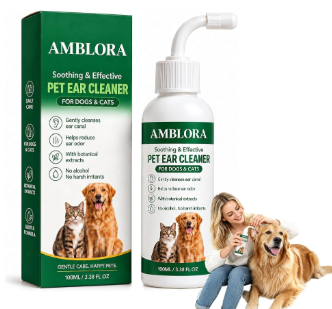

Amblora’s ad is hard to miss right now, the one promising a dog’s itching stops the same night you use it. That kind of claim, paired with over 25,000 reviews stamped on the page, is exactly the combination that makes us want to check who’s actually behind a product before anyone spends money on it. So we started where we always start, looking at who’s actually behind it. That’s where it got strange. Search “Amblora Ear Cleaner” on Amazon and the same bottle, same name, same claims, comes back under three different manufacturers. One says KINGUUR made it. Another says PETITION, not Amblora at all, despite Amblora sitting right there in the title. A third lists a Chinese company name that matches neither of the other two. Three different companies, apparently, all happening to make the exact same rinse. That’s worth sitting with before you trust the “4.8 out of 5 from 25,089 reviews” badge sitting on the official site.
Quick takeaway:
- Same “Amblora” product, at least three different manufacturer names on Amazon
- Two separate Amblora storefronts (amblora.com and amblora.shop) both showing the identical 4.8/5
- “94% saw results on the first rinse” type stats, all self-reported, no outside source
- Boric acid has real backing in an actual vet medication. Lactic acid, paired here instead of the usual acetic acid, doesn’t have that same specific backing
- Cleaning the ear and fixing what’s actually wrong with it are two different things, and the marketing blurs that line
What’s Actually in the Amblora Bottle
It’s a liquid rinse for dogs and cats, built around lactic acid and boric acid. Boric acid does have a real place in veterinary medicine. VCA Hospitals documents an actual product, acetic acid plus boric acid otic, sold as an antibacterial and antifungal ear cleaner for dogs and cats with ear infections, available over the counter but meant to be used under a vet’s direction. Amblora swaps the acetic acid for lactic acid. Maybe that works just as well, maybe it doesn’t, but it’s a different formula than the one with documented backing, not the same thing with a new label.
Then there’s the marketing on top of the chemistry, and it goes a lot further than “cleans wax.” Itching stops the same night. The smell disappears. The gunk comes out on the first use. There’s even a dig at supplements, something like, those take months because they’re treating the wrong end of the problem. It sells for $34.99, marked down from $69.99, with a 90-day money-back guarantee attached.
One Amblora Bottle, Three Manufacturers
Here’s the thing that actually changes how I read everything else on this page. Pull up Amblora listings on Amazon and the manufacturer field doesn’t match from one to the next. KINGUUR on one. PETITION on another, which isn’t even using the Amblora brand name as the seller, just slapping it on the title. A third lists a Chinese manufacturer that matches neither. That’s not three companies who happened to invent the same formula. That’s a generic rinse getting packaged under the Amblora name and handed to whichever reseller is listing it that week.
To be fair, Amblora’s own Terms of Service do name an actual operator, RISE GROUP LAB, with a Miami address. That’s more disclosure than plenty of sites in this category bother with. It just doesn’t explain why the same bottle also belongs to KINGUUR and PETITION depending on which listing you click.
About Those 25,000 Reviews
The main site shows 4.8 out of 5 from 25,089 reviews. There’s a second site, amblora.shop, running the same layout, same 4.8 rating. Both of these are numbers the company collects and posts itself, not anything sitting on an independent platform. Same story with the stat blocks on the page, 94% saw results first rinse, 91% said head shaking eased in days, 88% said the smell was gone same day. Round numbers, no sample size, nothing linking back to where they came from. Doesn’t mean they’re made up. Does mean there’s nothing outside the company’s own website to check them against.
Cleaning the Ear Isn’t the Same as Fixing It
This matters more than the manufacturer mess-up. The Merck Veterinary Manual is pretty direct about what’s usually behind a dog’s itchy, smelly ears, otitis externa, and it can come from allergies, bacteria, yeast, mites, something stuck in there. Treating it means finding whichever one it actually is. Merck’s own line is that unless every cause gets addressed, the problem just comes back. Cleaning helps, it’s even a recommended step before medication goes in, but a cleaner by itself isn’t the same as figuring out what’s wrong.
So if your dog just has regular wax buildup, sure, a same-night improvement from a rinse is believable. If something’s actually infected or flaring from an allergy, wiping away the visible mess can make things look and smell better for a bit while the real cause keeps doing its thing underneath. That gap, gunk’s gone versus problem’s fixed, is exactly what the marketing skips past.
Neither ingredient here is dangerous on its own. The one real caution applies to any ear cleaner, not just this one: don’t use it on an ear with a possibly ruptured eardrum, and if the head shaking, smell, redness, or discharge doesn’t clear up after a rinse or two, that’s the point to stop guessing and get an actual look from a vet.
Scam or Just Overhyped
I wouldn’t call this an outright scam. Nobody’s shown up saying they paid and got nothing. The ingredients have a real basis for cleaning ears. What’s actually going on is a generic rinse wearing a single brand name while being manufactured under at least three different identities, sold with same-night miracle language and stats nobody outside the company can check. Overhyped and poorly sourced is the fair read, not fraudulent.
As for whether it actually works, boric acid cleaning out wax and debris is plausible and has real precedent. Whether it stops itching “the same night” the way the ad promises isn’t something any independent source backs up for this specific formula. And is it worth buying? For plain routine cleaning, probably fine, though you’re likely paying a brand markup over a generic version of the same thing. For anything beyond routine wax, it’s not the right tool, and no amount of marketing changes that.
Before You Buy, Check These
Search the exact product name on Amazon and count how many different manufacturer names come up. Think about whether your dog’s ear issue is a one-off or something that keeps returning, since recurring usually means an actual infection a rinse won’t touch. And any percentage stat that isn’t linked to where it came from is just a nice number, not proof of anything either way.
How to Shop Smarter for Stuff Like This
None of this is specific to dog ear cleaners. The same handful of checks work on basically any product you see advertised hard online:
- Search the exact product name plus “Amazon” and see if the manufacturer field matches the brand name on the ad. A mismatch usually means a generic product with a marketing layer on top
- Treat any review count or percentage stat as meaningless unless it’s hosted somewhere other than the seller’s own site
- Look up who legally operates the site, usually buried in the Terms of Service or Privacy Policy, and check if that name matches the brand being advertised
- If the marketing claims something works dramatically faster than similar products, ask what’s actually different about the formula, not just the copywriting
- For anything health-related, check whether the product is positioned as routine care or as a fix for a real medical problem, those call for very different levels of evidence
If the Problem Keeps Coming Back
A rinse isn’t going to fix recurring yeast or bacteria. That needs an actual diagnosis. A vet visit tells you what’s really going on, and if you want something with real veterinary use behind it for routine cleaning, Virbac’s Epi-Otic or Zymox both have that track record.
This Same Setup Shows Up Elsewhere Too
One brand name standing in for a generic product sold under multiple identities isn’t unique to this bottle. Aveya Hair Growth Spray runs the identical playbook in a totally different category, self-reported numbers doing the heavy lifting, no single company actually standing behind the thing. A quick search for who actually manufactures something, not just who’s marketing it, catches this before you pay extra for the branded version of something generic.
Conclusion
The ingredients in Amblora aren’t dangerous, and boric acid specifically has real veterinary use behind it. But the brand is one thing covering for at least three different manufacturers, and the big numbers plastered across the site are entirely self-reported. The real issue isn’t even the branding mess, it’s that a rinse cleans what you can see without touching whatever’s actually causing a problem that keeps coming back. Fine for routine wax, probably at a markup over the generic version. If it’s recurring, skip another rinse and get a vet to look.
FAQ
Is Amblora Ear Cleaner a real product? Yes, it’s a real rinse, but it looks like a generic product sold under the Amblora name across multiple Amazon listings tied to different manufacturers.
Does Amblora Ear Cleaner actually work? Boric acid has a real basis for cleaning ears in veterinary use. The same-night results claimed on the site aren’t backed by any independent study of this specific product.
Is Amblora Ear Cleaner safe for dogs and cats? The ingredients themselves are common in pet ear care. Don’t use it, or any ear cleaner, on a possibly ruptured eardrum, and get a vet to check anything that doesn’t clear up after a rinse or two.
Why does Amblora show different manufacturers on Amazon? Listings for the same product show different manufacturer names, including KINGUUR and PETITION, which points to a generic product resold under one brand name rather than made by a single company.
Is the 90-day money-back guarantee real? It’s stated on Amblora’s own site. Worth keeping your order confirmation and tracking info either way, in case a refund needs to be enforced.