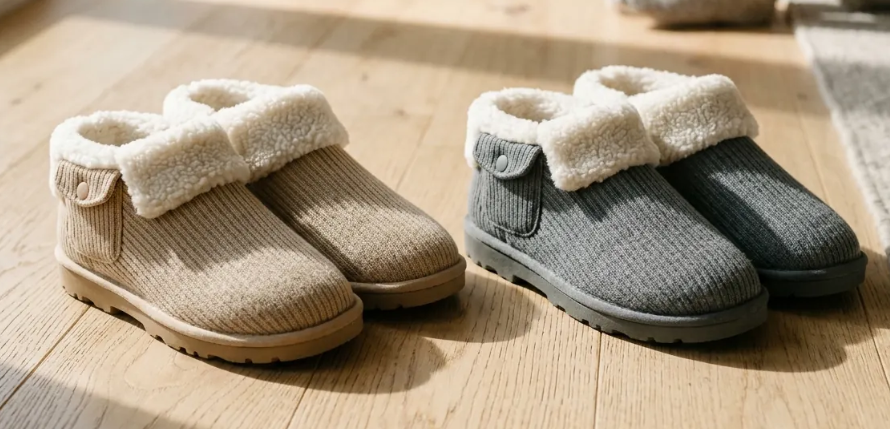

Wattoes Heated Slippers are promoted as a simple solution for cold feet: rechargeable slippers with built-in heating pads, three temperature settings, and no cable restricting movement around the house. The Facebook advertising adds attractive product photographs, large discounts, customer testimonials, and logos from familiar media outlets. It is an appealing offer, particularly when the weather gets cold.
But the details behind the promotion are less reassuring. The product page gives conflicting battery capacities, the advertised six-hour runtime applies only to the lowest heat setting, and the media logos are not supported by links to actual coverage. The seller’s 30-day money-back guarantee also comes with return costs and conditions that are easy to overlook when you’re concentrating on the discount.
Table of Contents
- About Wattoes Heated Slippers
- What You Would Actually Be Buying
- Color, Fit, and the Hygiene Exception
- The Battery and Runtime Claims Need Context
- Media Logos Are Not Product Reviews
- The Facebook Review Page Is Not Independent Proof
- How the Wattoes Purchase Flow Works
- Who Is Responsible for the Order?
- Why the Heat-Safety Advice Deserves Attention
- How to Check an Online Store Before You Buy
- What to Do If You Already Ordered from Wattoes
- Frequently Asked Questions
- The Bottom Line
About Wattoes Heated Slippers
Ordinary heated slippers with some unanswered questions
Wattoes are advertised as indoor slippers with electrical heating pads beneath the soles. Each slipper has a zippered side pocket for a rechargeable power bank, allowing the wearer to move around without remaining connected to a wall outlet.
The seller lists three heat settings, a washable polyester-and-cotton exterior, and several hours of operation per charge. None of that is particularly unusual for rechargeable heated footwear. The technology itself is plausible.
What needs closer attention is the information supplied for this particular product. The main description says the slippers come with two 2,500 mAh batteries, while the FAQ refers to 5,000 mAh power banks. The page also advertises temperatures as high as 65°C without providing independent measurements or product-specific safety documentation.
The discount is not the only thing to check
The captured checkout lists a single pair at $59.99, with lower per-pair prices for larger packages. The four-pair option works out to $35.97 per pair, but requires an upfront payment of $143.88.
There are other details worth noticing:
- The advertised six-hour runtime applies to Low, not High.
- The main product description and FAQ do not clearly agree on battery capacity.
- The sales page displays CNN, Forbes, NBC, The New York Times, and The Washington Post logos without supporting editorial links.
- The checkout contains unrelated clothing-restoration text.
- The linked refund policy requires customers to pay return shipping.
- The Facebook review page displays zero customer reviews and has an ordering link that leads to a broken page.
A purchasing warning, not proof that the product cannot work
Rechargeable heated slippers are a legitimate product category. That does not establish that Wattoes delivers the advertised performance or that the seller’s promotional claims are dependable.
The concerns here are specific to the offer: unclear specifications, unsubstantiated publicity, a confusing purchase flow, and return conditions that make getting your money back less straightforward than the guarantee suggests.
What You Would Actually Be Buying
The product page describes slippers with a polyester-and-cotton upper, heating pads positioned beneath the center of each sole, and a button for switching between three temperature settings. Each slipper is supposed to have its own rechargeable power bank stored in a zippered pocket. This is what makes the design cordless, although it also means you have two separate batteries to charge and maintain.
The advertised charging time is approximately four to four-and-a-half hours using a 5V/2A supply. The supplied materials do not clearly establish whether a suitable wall adapter is included. There are also details that photographs cannot tell you. They do not show the quality of the wiring, the battery protection circuitry, the temperature-control mechanism, or how the heating pads behave when repeatedly compressed under someone’s feet. Those details matter because the product is worn while walking and places electrical heating elements close to the skin. A seller offering this type of footwear should make its model information, operating instructions, and safety documentation easy to find.
Color, Fit, and the Hygiene Exception
The captured checkout lists beige in a women’s 4–8 range and gray in a men’s 7.5–10.5 range. These are broad size ranges, so check the actual size chart before ordering rather than assuming the slippers will fit comfortably throughout.
The product photographs also do not establish how the heating area sits beneath different foot sizes. If the slippers are too loose or too tight, the position of the heating pad may not feel the same for every wearer.
The return policy creates another question. It includes restrictions involving opened hygiene and personal-care products, but does not clearly explain how those restrictions apply to Wattoes. Can someone try on the slippers indoors and still return them if the fit is wrong? The policy does not give a sufficiently clear answer.
That is worth settling before ordering, especially if the slippers are intended as a gift. A product that cannot be comfortably tried on without risking return eligibility is not quite the easy purchase its advertising suggests.
The Battery and Runtime Claims Need Context
The battery description is one of the clearest inconsistencies on the product page. The main description specifies two 2,500 mAh power banks, while the FAQ refers to 5,000 mAh power banks.
There is a possible explanation: two batteries rated at 2,500 mAh each would have a combined capacity of 5,000 mAh. But the FAQ does not clearly say that it is referring to their combined capacity. Nor should customers assume that each slipper has a 5,000 mAh battery.
The seller also needs to provide the battery voltage and energy rating. Milliamp-hour figures alone do not give the complete picture of how much energy a battery stores.
The runtime claims are easier to interpret:
| Heat setting | Advertised runtime |
|---|---|
| High | Approximately 3 hours |
| Medium | Approximately 4.5–5 hours |
| Low | Approximately 5.5–6 hours |
The six-hour figure is therefore not a promise of six hours on maximum heat. Anyone buying the slippers because they expect strong warmth throughout a long evening should pay attention to that distinction.
The temperature claims also need context. Wattoes lists Low at 40–45°C, Medium at 50–55°C, and High at 60–65°C. These are seller-provided figures, not independently measured skin-contact temperatures.
A displayed temperature range does not establish how evenly the heat spreads across the sole or how reliably the controls prevent excessive temperatures. No physical pair or battery was tested for this investigation, so the advertised performance should not be mistaken for verified results.
Media Logos Are Not Product Reviews
The sales page displays CNN, Forbes, NBC, The New York Times, and The Washington Post beneath an “As Seen On” heading. There are no supporting links to articles, product tests, or editorial coverage of Wattoes.
That is an important distinction. A publication’s logo on a sales page does not mean its journalists tested the slippers or recommended them. If the seller wants customers to believe the product received media coverage, it should be able to identify the actual articles.
The page also promotes a 4.9-star rating and thousands of verified reviews. However, the reviewed materials do not clearly identify the independent platform hosting those reviews or explain how the purchases were verified.
One testimonial is headed “Saving me 100$s on Bills!” but the accompanying text discusses washing the slippers. It does not explain how much energy was saved, what heating equipment was used before, or how the claimed savings were calculated.
Heated slippers might make someone more comfortable without turning up the heating in a room. But that does not automatically translate into a particular reduction in household bills. The testimonial does not substantiate its headline.
Seller-selected testimonials can be useful for understanding the claims being made, but they are not the same as an independently verifiable collection of customer experiences.
The Facebook Review Page Is Not Independent Proof
A Facebook page using the name WattoesHeatedSlippers.OfficialStore presents itself as a Wattoes review destination. Its displayed title refers to reviews for 2027, yet the page information examined for this investigation showed zero customer reviews.
The public contact details repeat Spark Tek’s email address, telephone number, and New York business address. That connects the information displayed on the Facebook page with the seller details used by the Wattoes sales offer, but it does not establish who operates the account or whether the company has authorized its content.
The ordering link is another problem. Its Start Order button points to:
universalsupplements24x7.com/buy-wattoes-heated-slippers/
That is not the Wattoes product page. The supplied destination returned a 404 error when checked.
A Facebook page with an OfficialStore name is not proof of an authorized retailer. Nor does a page containing promotional posts establish that thousands of customers have reviewed the product.
For anyone who has already ordered, the safer approach is to work from the original receipt and the merchant details shown during payment rather than submitting payment information or order documents through an unrelated, broken route.
How the Wattoes Purchase Flow Works
Step 1: The discount encourages a larger order
The sales page advertises discounts of up to 70% and uses stock messaging to make the offer feel time-sensitive. The captured checkout lists these package prices:
| Package | Total price | Price per pair |
|---|---|---|
| 1 pair | $59.99 | $59.99 |
| 2 pairs | $107.90 | $53.95 |
| 3 pairs | $133.08 | $44.36 |
| 4 pairs | $143.88 | $35.97 |
The larger packages do reduce the price per pair. However, the lowest unit price requires buying four pairs and spending $143.88 upfront.
The reference prices also deserve a closer look. The three-pair package is listed at $133.08 against a reference price of $359.70. That is approximately 63% off, not the advertised 65%. The four-pair package works out to approximately 70% below its $479.60 reference price.
This arithmetic difference does not prove the seller is deliberately misleading customers. But the reference prices themselves have not been established as genuine previous selling prices, so the percentage-off claims should not be taken at face value.
Step 2: The checkout offers additional protection
The checkout also presents an optional one-year protection plan for $9.95. That is an additional charge, separate from the standard return policy.
The supplied information does not establish the complete coverage, exclusions, or claim procedure for this plan. Before selecting it, customers should establish exactly what it covers and whether it provides anything beyond the seller’s existing obligations.
Step 3: The final total needs checking
Shipping and final charges depend on the order selection and destination. The product subtotal is not necessarily the amount that will appear on the payment confirmation.
The checkout also contains unrelated clothing-restoration text, including references to removing fabric pills. That material has nothing to do with heated slippers and looks like leftover content from another sales template.
It is a small detail, but customers should not have to navigate unrelated product information while entering payment details for a supposedly specialist footwear product.
Step 4: A return is not as simple as the guarantee suggests
The checkout links to Spark Tek’s refund policy. Customers are required to contact support before returning an item, obtain an approved return address, and provide valid tracking information.
The policy also makes customers responsible for return postage and excludes original shipping fees from refunds. Approved refunds may have shipping and handling charges deducted.
That is considerably less generous than the impression created by a short “30-day money-back guarantee” message.
Who Is Responsible for the Order?
Wattoes directs customers to Spark Tek
The Wattoes sales materials link to Spark Tek for customer contact information, terms, and refund conditions. The linked Spark Tek website identifies Straight Commerce Inc. as the company behind the storefront.
Its published business address is:
100 Church Street, 8th Floor, New York, NY 10007, United States.
That is the address displayed on the linked business website. It is not necessarily the warehouse or return facility for Wattoes orders. The refund policy says customers must obtain the approved return destination from support.
Contact information
The linked Spark Tek website publishes:
- Email: help@spark-tek.co
- Telephone: +1 424-250-4182
- Business name: Straight Commerce Inc.
These are the seller’s published contact details. They do not establish that support will resolve every complaint, but they give customers a starting point if they need to ask about an order.
The storefront sells more than heated slippers
Spark Tek’s website presents a broad collection of unrelated products, including earbuds, smartwatches, portable fans, and security cameras. Its homepage also contains testimonials referring to different products under a general “Verified Users” rating.
That is relevant because the customer feedback displayed on the storefront should not automatically be interpreted as reviews of Wattoes. A general store rating does not tell you how the heated slippers perform.
Customer complaints about Spark Tek
The Spark Tek Trustpilot profile currently displays a 1.5-out-of-5 TrustScore from 43 reviews. Many of the visible complaints concern other products, including delivery delays, products that allegedly did not perform as advertised, and difficulties obtaining refunds.
The Better Business Bureau profile for Spark Tek also displays an F rating and identifies two complaints to which the business did not respond. These are complaints about the storefront, not verified complaints about Wattoes Heated Slippers specifically.
That distinction matters. It would be unfair to claim that every Wattoes customer will have the same experience. But the seller’s broader feedback is relevant when deciding how much confidence to place in its customer-service promises.
Why the Heat-Safety Advice Deserves Attention
Wattoes recommends using the Low setting for people with reduced heat sensitivity. That suggestion should not be treated as proof that the slippers are suitable for anyone who cannot reliably feel temperature changes.
People with diabetes-related nerve damage or other forms of neuropathy may not notice excessive heat developing beneath their feet. The US National Institute of Diabetes and Digestive and Kidney Diseases warns people with diabetes-related nerve damage against using heating pads or hot-water bottles on their feet.
A lower temperature setting does not restore lost sensation. Anyone with reduced foot sensation or circulation concerns should seek appropriate medical advice before using electrically heated footwear.
There have also been safety warnings and recalls involving other heated foot products. For example, the US Consumer Product Safety Commission warned consumers about iHeat heated insoles after reports of fires, explosions, and burn injuries. It also announced a recall of 32 Degrees heated socks following reports of heat-related injuries.
These notices concern different products and manufacturers. They do not establish that Wattoes has the same defects or has been recalled. They do show why battery protection, temperature controls, and product-specific safety information matter for footwear containing electrical heating components.
How to Check an Online Store Before You Buy
Before ordering from a Facebook advertisement, check the actual seller and the conditions attached to the offer.
- Look for a company name that matches the business named in the terms and checkout.
- Read the refund policy before paying, especially the return-shipping and deduction rules.
- Check whether the product has a model number, operating manual, and clear battery specifications.
- Look for customer feedback about the exact product, not just the seller’s other merchandise.
- Calculate the actual package price rather than relying on the advertised discount percentage.
- Check the final checkout total and make sure the payment destination belongs to the seller you intended to use.
- Save screenshots of the offer, policies, and checkout before completing an order.
You can also use the MalwareTips Website Scanner to check a website. A scan cannot establish whether a product performs as advertised or whether a seller will honor its refund policy, so it should not replace checking the actual business and purchase conditions.
What to Do If You Already Ordered from Wattoes
If you have already paid, keep the order confirmation and the exact offer you purchased. If something goes wrong, the details matter.
- Save the advertisement and product page. Keep screenshots of the battery specifications, runtime claims, discounts, and return guarantee.
- Check your order confirmation. Record the merchant name, payment descriptor, order number, package quantity, and amount charged.
- Contact the seller in writing. Explain whether the problem concerns delivery, incorrect items, battery information, heating performance, or a refund.
- Ask for return instructions before shipping anything. Obtain the approved return address and confirm any deductions from the refund.
- Document the product if it arrives. Photograph the packaging, battery labels, missing components, and any defects. Do not dismantle or deliberately overheat the battery.
- Be careful with partial-refund offers. If the seller proposes that you keep an unsuitable or defective item in exchange for a partial refund, compare that offer with the full refund terms before accepting.
- Keep track of deadlines. Do not allow repeated support exchanges to make you miss your payment provider’s dispute window.
- Contact your payment provider if necessary. Ask about its dispute process if the seller does not resolve a legitimate problem. Consumers in the United States, United Kingdom, Canada, and Australia can also consult the relevant consumer-protection channels for guidance.
- Watch out for recovery scams. Be wary of anyone who contacts you unexpectedly and promises to recover your money in exchange for an upfront payment.
Frequently Asked Questions
Are Wattoes Heated Slippers a scam?
The available findings do not prove that every order is fraudulent. However, the conflicting battery specifications, unsupported media logos, questionable review presentation, and return conditions give buyers good reasons to be cautious.
Do Wattoes Heated Slippers really last six hours?
The seller advertises up to approximately six hours on Low. Its stated runtime on High is around three hours. Neither figure has been independently tested for this article.
Are the batteries 2,500 mAh or 5,000 mAh?
The product description lists two 2,500 mAh power banks, while the FAQ refers to 5,000 mAh power banks. The seller does not clearly explain whether the larger figure represents the combined capacity of both batteries.
Did CNN, Forbes, or NBC review Wattoes?
The sales page displays these logos, along with The New York Times and The Washington Post, but does not provide links to supporting editorial coverage. The claimed coverage could not be verified.
Does Wattoes offer free returns?
No. The linked Spark Tek refund policy makes customers responsible for return shipping. Original shipping fees are also non-refundable, and approved refunds may have shipping and handling charges deducted.
Who operates the Wattoes store?
The Wattoes sales materials link to Spark Tek for customer policies and support. The linked Spark Tek website identifies Straight Commerce Inc. as the business behind the storefront.
Can people with diabetes use Wattoes Heated Slippers?
People with diabetes-related nerve damage may have reduced foot sensation and an increased risk of burns from direct heat. The seller’s recommendation to use Low should not be treated as medical safety advice. Anyone with reduced sensation should consult a healthcare professional before using heated footwear.
The Bottom Line
Wattoes Heated Slippers have an appealing idea behind them, but the offer asks customers to accept too many unanswered questions. The battery specifications do not clearly agree, the media logos are unsupported by identifiable coverage, and the customer testimonials do not provide a reliable picture of actual product performance.
The return policy is another reason to think twice. The advertised 30-day guarantee does not mean customers can simply send the slippers back at no cost. They must contact support, obtain an approved return address, pay return postage, and potentially accept deductions from the refund.
The associated Spark Tek storefront also has poor public customer feedback, although those complaints concern other products and should not be presented as Wattoes-specific failures.
I would avoid ordering through this offer unless the seller first provides clear battery specifications, proper product safety information, and written confirmation of the return conditions. A large discount and a familiar media logo strip are not enough to make those unanswered questions disappear.
Read also >>> Nthropoid.com Reviews: Is Nthropoid Legit or a Scam?

[…] Read also >>> Wattoes Heated Slippers Review: A Good Winter Buy or a Waste of Money? […]