
A page claiming you can get a $750 Best Buy reward sounds like an easy win, especially when the instructions are reduced to four simple steps: click the button, enter some basic information, complete the required offers, and claim your reward.
That is not the full story. I looked into StudentSavingsHub.com and found that it is not an official Best Buy rewards website. More importantly, Best Buy isn’t the only major brand this domain has used. The same website has appeared with different retailer branding and different reward amounts. That tells us much more about what StudentSavingsHub actually is.
Quick Takeaways
- StudentSavingsHub.com was registered on February 18, 2026.
- The domain expires in February 2027.
- The current page advertises a $750 Best Buy “Exclusive Offer.”
- StudentSavingsHub is not an official Best Buy website.
- The reward requires users to complete third-party offers.
- The site has previously appeared using other major brands.
- Previous versions have advertised different reward amounts.
- The “claimed $750” notification is designed to make the promotion appear active and popular.
- Clicking through can lead users into an affiliate advertising funnel rather than directly to the retailer.
- I consider the StudentSavingsHub $750 reward misleading and would avoid it.
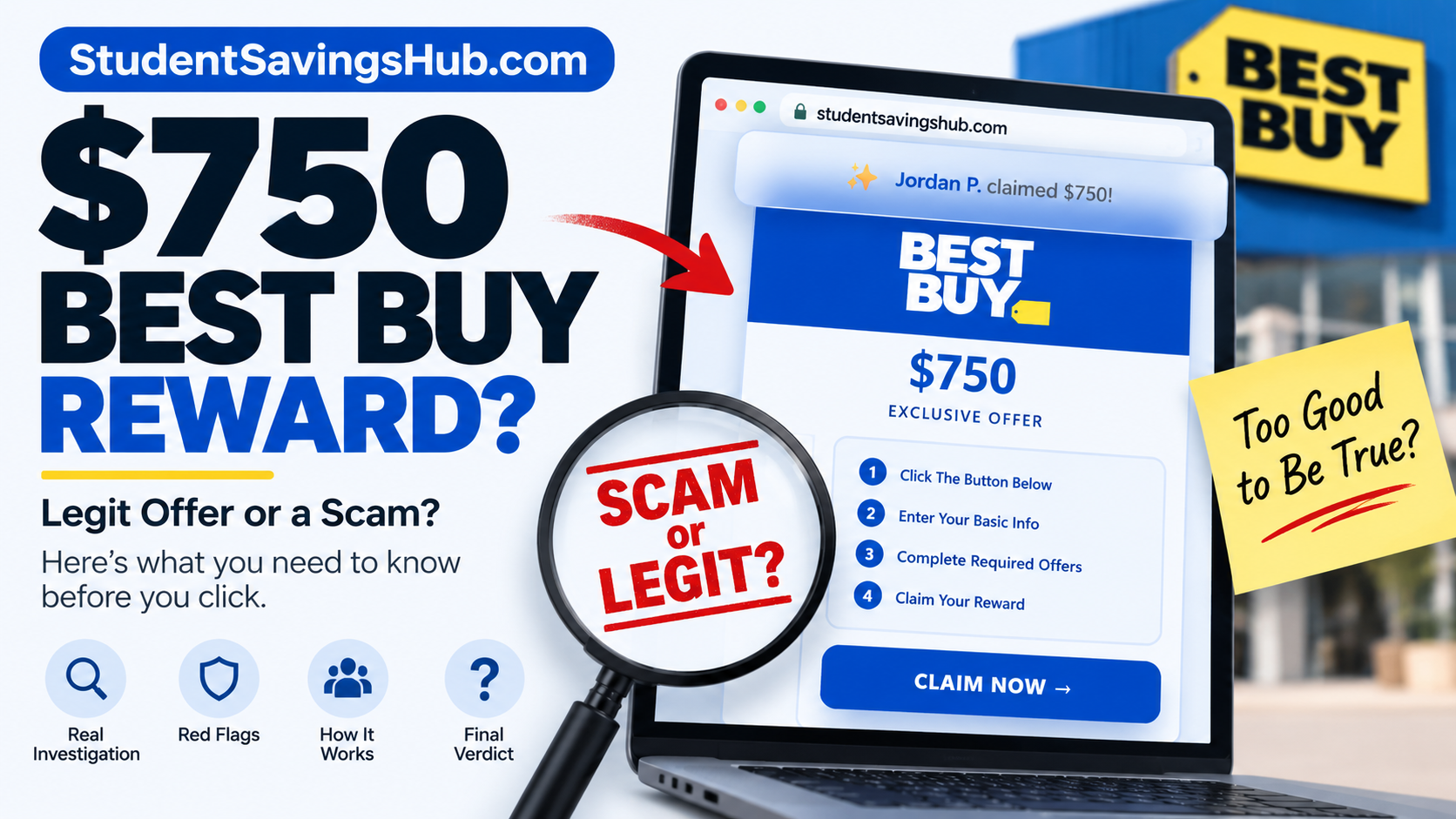
Table of Contents
- Quick Takeaways
- What Is the StudentSavingsHub $750 Best Buy Offer?
- StudentSavingsHub Isn’t a Best Buy Website
- The Same Website Has Used Other Major Brands
- What Happens When You Click the Claim Button?
- The “Jordan P. Claimed $750!” Message Is Another Pressure Tactic
- The Domain Is Still Very New
- How the StudentSavingsHub Reward Funnel Works
- Why “Complete Required Offers” Matters
- A Pattern I’ve Seen With Similar $750 Giveaways
- How to Spot Similar Reward Scams
- What To Do If You Already Entered Your Information
- Is StudentSavingsHub.com Legit? My Verdict
What Is the StudentSavingsHub $750 Best Buy Offer?
The page shown in the promotion is deliberately simple. It displays Best Buy’s recognizable logo, promises $750, labels it an “Exclusive Offer,” and gives visitors four instructions:
- Click the button.
- Enter your basic information.
- Complete required offers.
- Claim your reward.
The third step is the part people need to pay attention to. This isn’t simply a Best Buy gift card waiting to be collected after answering a few questions. The “required offers” are central to how these reward funnels work.
StudentSavingsHub Isn’t a Best Buy Website
The branding creates an obvious impression. Best Buy’s logo dominates the page, the $750 amount sits directly beneath it, and the claim button appears below. Someone arriving through a social-media advertisement could reasonably assume they have landed on a Best Buy promotion.
But the domain is StudentSavingsHub.com, not a Best Buy domain. I also couldn’t find evidence establishing StudentSavingsHub as an official Best Buy rewards program. The retailer branding appears to be the hook used to get visitors interested in the reward rather than evidence that Best Buy itself is running the promotion.
The Same Website Has Used Other Major Brands
This was the most revealing part of my research. StudentSavingsHub hasn’t always been a “$750 Best Buy” page. Previous captures of the domain have shown it using John Lewis, LEGO, Argos, JB Hi-Fi, and SeatGeek-related branding. One version promoted a £750 John Lewis reward, while another advertised a $500 LEGO offer. The basic reward-page concept remained even as the recognizable company presented to visitors changed.
That makes it difficult to believe StudentSavingsHub exists to distribute genuine rewards for one particular retailer. It behaves much more like a reusable promotional landing page that can be changed depending on the campaign, location or audience being targeted.
What Happens When You Click the Claim Button?
Earlier testing of the StudentSavingsHub funnel found that its reward button sent visitors through an affiliate link rather than to the retailer displayed on the landing page. One documented version redirected users to an advertising page containing unrelated commercial offers, including surveys and gambling promotions.
This explains why “Complete Required Offers” appears in the instructions. The big retailer reward gets the visitor through the door, but the actual process can involve registrations, surveys, trials and other third-party deals. The people operating the referral chain may earn money when users complete certain actions.
The “Jordan P. Claimed $750!” Message Is Another Pressure Tactic
At the top of the page you sent me is a notification saying “Jordan P. claimed $750!” It looks like evidence that another person has successfully completed the process.
But a message appearing on a landing page isn’t independent proof that someone received $750. These activity notifications are commonly used to create social proof. If visitors believe other people are successfully collecting the reward right now, they’re less likely to question whether completing all the required offers is actually worthwhile.
The Domain Is Still Very New
StudentSavingsHub.com was registered on February 18, 2026, with registration currently running until February 18, 2027. Its public WHOIS information is privacy protected.
Being new or using WHOIS privacy doesn’t make a website fraudulent. Here, the domain history matters because this young website has already cycled through multiple recognizable brands and reward campaigns. That activity tells us far more than domain age alone.
How the StudentSavingsHub Reward Funnel Works
The strategy starts with something valuable enough to stop someone scrolling: $500, $750 or a similarly large reward from a familiar retailer. A clean landing page, recognizable logo, fake-looking activity notifications and a large claim button make the process appear much simpler than it really is.
After clicking, the visitor can be moved into third-party offers. Each additional step creates another opportunity to collect information, generate advertising revenue or earn affiliate commissions. By that point, the retailer logo that originally attracted the person may have little to do with what they’re being asked to complete.
Why “Complete Required Offers” Matters
This wording is easy to skim past, but it changes the entire promotion. You’re not being told that Best Buy simply selected you for a $750 gift card. You’re being told that obtaining the advertised reward depends on completing additional offers.
Those requirements can become time-consuming and may involve sharing personal information or signing up for services. Before entering an email address, phone number, payment information or other personal details, you should know exactly which company is collecting it and what you’ve agreed to.
A Pattern I’ve Seen With Similar $750 Giveaways
StudentSavingsHub follows a pattern I’ve seen while reviewing other large gift-card promotions, including the CircleVoucher $750 Target offer and TapGiftCard $750 Costco promotion. A recognizable retailer and unusually large reward get most of the attention, while the conditions attached to actually qualifying receive much less emphasis.
The retailer changes, but that’s not the important part. Whether the page says Best Buy, Costco, Target or another familiar company, always check the domain hosting the promotion and read the qualification requirements before entering any information.
How to Spot Similar Reward Scams
Start with the web address instead of the logo. If a page claims to offer a huge reward from Best Buy but you’re nowhere near an official Best Buy domain, verify the promotion independently before continuing. Never assume a company is involved simply because its logo appears prominently on a webpage.
Also pay attention to phrases such as “complete required offers,” “exclusive offer,” “claim now,” or messages claiming another person has just received the prize. None proves a scam by itself, but together they can reveal that you’re dealing with a lead-generation or affiliate reward funnel rather than the straightforward giveaway you expected.
What To Do If You Already Entered Your Information
If you only provided an email address or phone number, expect an increase in promotional emails, texts or calls and be cautious about clicking links in anything that follows. Don’t provide additional information simply because a message claims you’ve already progressed toward the reward.
If you entered card details or signed up for paid trials while completing offers, check your statements and subscription terms carefully. Cancel unwanted subscriptions through the appropriate provider and contact your card issuer promptly if you notice charges you didn’t authorize.
Is StudentSavingsHub.com Legit? My Verdict
I would avoid the StudentSavingsHub $750 Best Buy offer. My biggest concern isn’t simply that the domain was created in February 2026. It’s that the same domain has repeatedly switched between well-known brands while keeping the large-reward formula.
The Best Buy logo makes the current promotion look familiar, but StudentSavingsHub is not Best Buy. The reward page is better understood as the beginning of an affiliate offer funnel where visitors may have to complete third-party deals before becoming eligible for anything. I wouldn’t enter my personal information or chase the promised $750.
