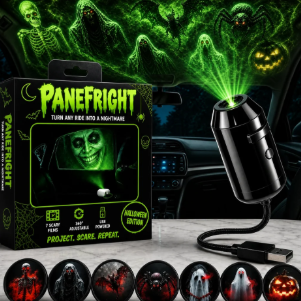

The PaneFright Car Projector is one of those Halloween gadgets that sounds like a fun idea until you start looking closely at what’s actually being sold. The advertisement shows creepy figures appearing through car windows, making it look as though something frightening is sitting inside the vehicle. For $34.99, I can understand why someone would consider buying it for Halloween night. But I found something confusing. The car projector is advertised as a simple USB-powered gadget with seven scary scenes, while other PaneFright listings promote a more expensive projector for household windows, complete with smart features and additional accessories. These aren’t necessarily the same device, yet the branding and marketing are similar enough to confuse buyers. I looked into the product claims, the different sales pages, and the customer feedback to see whether PaneFright is worth buying or just another Halloween gadget being oversold.
Quick Takeaway
- Product: PaneFright Car Projector
- Website: Frightpane.com
- Advertised price: $29.99 on the latest examined listing, although an earlier version showed $34.99
- Main claim: Projects frightening Halloween scenes through car windows
- Power: USB connection
- Included effects: Six scary scenes on the latest listing
- Main concerns: Unverified projection quality, inconsistent product information, and seller-published reviews
- My verdict: I like the concept, but I wouldn’t order without clearer proof of how well the device works.
Table of Contents
- Quick Takeaway
- What Exactly Is the PaneFright Car Projector?
- Will the Halloween Effects Look as Good as the Videos?
- The PaneFright Listings Are Surprisingly Inconsistent
- The Customer Reviews Don’t Convince Me
- The Price, Sales Claims, and Seller Information
- Is the PaneFright Car Projector a Scam or Worth Buying?
- Tips for Shopping Safely
- My Final Verdict
What Exactly Is the PaneFright Car Projector?
PaneFright is advertised as a small Halloween projector that connects to your car’s USB port and displays spooky scenes through the windows. The idea is to make it look like there’s a ghost, monster, or other frightening figure inside the vehicle, particularly when the car is parked somewhere people can see it. The seller says it takes only seconds to set up: connect the USB cable, point the device toward a window, and select one of the included effects. It also claims the projector can be used on walls and other surfaces, so it isn’t limited to cars. The concept is believable because small projection devices already exist, and Halloween effects can be displayed using fairly basic hardware. But the website doesn’t tell buyers much about the actual projector. There’s no clear native resolution, measured brightness, projection distance, or detailed explanation of how the scenes are stored and selected. It advertises six included scenes on the latest listing, although an earlier version mentioned seven. That’s not a huge difference, but it shows why buyers shouldn’t assume every advertisement describes exactly the same package.
Will the Halloween Effects Look as Good as the Videos?
I wouldn’t expect the projections to look quite as dramatic as the promotional demonstrations. Projectors depend heavily on lighting, distance, and the surface they’re aimed at. A small USB-powered unit might produce a visible image in a dark environment, but making a convincing ghost appear through a car window is a different challenge. Ordinary clear glass isn’t a proper projection screen, and some of the light will pass through it rather than forming a bright image. Tinted windows can create additional problems, depending on how the projector is positioned. The seller recommends using the device after dusk and aiming it at a light-colored window, wall, or smooth surface, which suggests that the lighting conditions matter quite a bit. I would expect the best results with a suitable projection film or translucent screen rather than bare glass. There’s also the question of power. The product is advertised as USB-powered, but the website doesn’t clearly state its power requirements or how bright the projector can become. Without an unedited demonstration showing the device, the car window, and the projected image together, I can’t judge whether the effects will be clearly visible from outside. I certainly wouldn’t buy it expecting the kind of cinematic result shown in the advertising.
The PaneFright Listings Are Surprisingly Inconsistent
One thing I found confusing is that Frightpane.com sells both the PaneFright Car Projector and another product called The PaneFright Projector. The car version has been advertised for around $29.99 to $34.99, while the other listing shows $69.99. The more expensive product is described as a multimedia projector for Halloween window displays, but parts of its page still use the car projector’s description, including instructions about plugging it into a vehicle’s USB port. That looks like product-page content being reused without properly explaining the differences. The separate Panefright.com website promotes another Halloween window projector that works with a bedsheet, smartphone, USB content, and an indoor setup. Independent research has also identified the projector shown in that campaign as resembling a generic HY300-style mini projector, although its exact internal configuration hasn’t been confirmed. That doesn’t prove the cheaper car projector uses the same hardware. In fact, I wouldn’t assume it does. My concern is that buyers could easily confuse these offers and end up ordering a different type of projector from the one they saw advertised. If a seller has multiple devices under similar names, it should be straightforward to compare their specifications and understand what makes one cost twice as much as another.
The Customer Reviews Don’t Convince Me
Frightpane.com has displayed more than 1,200 reviews for the PaneFright Car Projector, along with testimonials describing customers frightening their neighbours and getting impressive results from the projections. One reviewer supposedly used the device while driving around, while another describes parking near a sidewalk and surprising people passing by. These stories make the product sound entertaining, but they’re published on the seller’s own website, and I couldn’t independently verify the review count or the experiences described. I also noticed that the car projector and the more expensive PaneFright listing share very similar promotional material and customer testimonials. That’s another reason I wouldn’t treat the reviews as dependable evidence of performance. Separately, Panefright.com, which sells a related Halloween window projector, has received a negative Trustpilot complaint from a customer who said the delivered package was incomplete and didn’t match expectations. The reviewer also shared what they described as a seller response refusing a refund after delivery. That complaint concerns Panefright.com, not a confirmed purchase from Frightpane.com, so it shouldn’t be presented as direct evidence against the car projector seller. Still, it shows why checking the exact website and its refund terms matters when several similar products are being advertised under nearly identical names.
The Price, Sales Claims, and Seller Information
The latest Frightpane.com listing I examined showed the car projector at $29.99, although an earlier version advertised it for $34.99. The page also uses limited-stock messaging and has displayed claims of more than 100 orders in the previous 24 hours. I couldn’t independently verify those sales figures, and I wouldn’t let them influence my decision. The website advertises free worldwide shipping, but the product page doesn’t provide much useful information about delivery times or what happens if the device arrives defective. I also noticed an unfinished email subscription message in the footer, which makes the storefront look less carefully maintained than I’d expect from a business claiming substantial sales. The website has a contact page and links to legal policies, but that alone doesn’t establish a reliable history of fulfilling orders or processing refunds. At roughly $30, PaneFright isn’t especially expensive compared with larger projectors, but the price still needs to make sense for the hardware. Without confirmed brightness, resolution, or independent performance testing, I can’t tell whether buyers are getting a useful little Halloween gadget or an underpowered novelty item that looks much better in the advertisement than it does in person.
Is the PaneFright Car Projector a Scam or Worth Buying?
I wouldn’t call PaneFright a confirmed scam because the idea itself is technically possible, and I haven’t established that Frightpane.com routinely takes payments without delivering orders. But I don’t think the seller has provided enough information to justify buying it confidently. The device might produce a fun effect in a dark environment, particularly if you use a suitable projection surface and keep your expectations reasonable. What I don’t believe is that buyers should expect a frighteningly realistic figure to appear through any car window simply by plugging in a small USB gadget. The inconsistent product descriptions, lack of meaningful technical specifications, and unverified testimonials make the purchase harder to recommend. I’d rather buy a projector from a seller that provides a genuine demonstration and clearly identifies the hardware. If you’re decorating a parked car for Halloween, I’d also avoid using projections while driving, especially anything that could obstruct visibility or distract other road users.
Tips for Shopping Safely
- Check which PaneFright product you’re ordering. The car projector and the more expensive window projector are advertised separately. Compare the descriptions carefully instead of assuming they’re identical.
- Look for genuine demonstrations. A useful video should show the actual projector, its placement, and the image appearing through a real car window without dramatic editing.
- Confirm the specifications. Check the brightness, resolution, power requirements, included scenes, and whether additional projection film or accessories are necessary.
- Read the refund policy. Find out whether you can return the projector after testing it, who pays return postage, and where the item must be sent.
- Search for independent reviews. Give more weight to buyers showing their own devices than to anonymous testimonials on the seller’s website.
- Use a payment method with buyer protection. Keep screenshots of the advertisement, your receipt, and the order confirmation in case the product doesn’t arrive or differs from its description.
- Trust your instincts. If the advertising looks too good to be true, it probably is. Don’t let limited-stock warnings, huge discounts, or impressive Halloween videos pressure you into ordering before checking the details.
My Final Verdict
The PaneFright Car Projector could be a fun Halloween decoration, but I wouldn’t buy it based on the advertising alone. The seller hasn’t shown enough about the actual hardware or how convincingly it projects through car windows. And with several similar PaneFright products being promoted across different websites, it’s too easy to misunderstand what you’re paying for. I’d wait for genuine customer demonstrations or choose a better-documented projector from an established retailer.
Also Read >>> Fosi Audio DAP Neo Review: Is This $80 Music Player Worth Buying in 2026?



[…] Also Read >>> PaneFright Car Projector Review: A Clever Halloween Gadget or a Waste of Money? […]