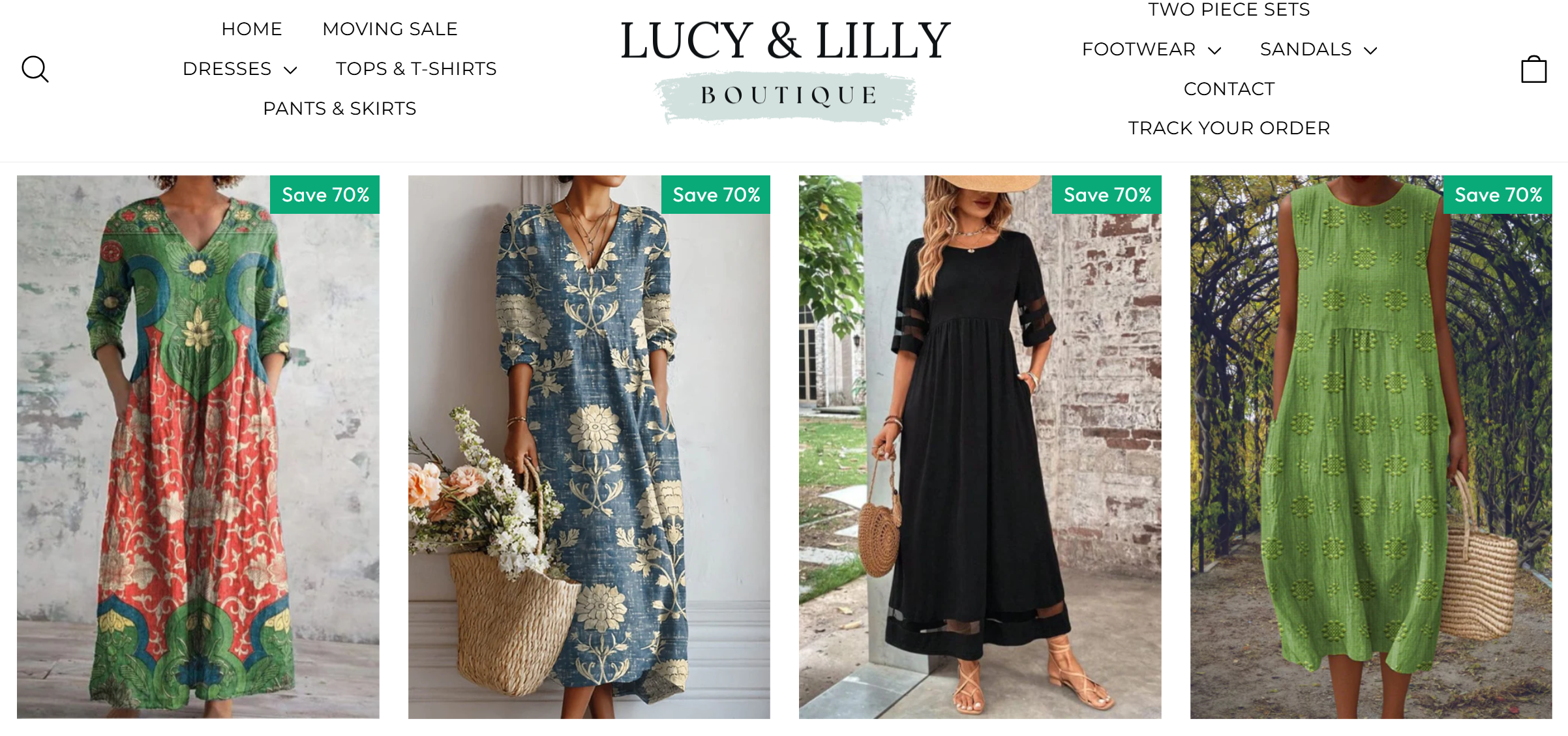

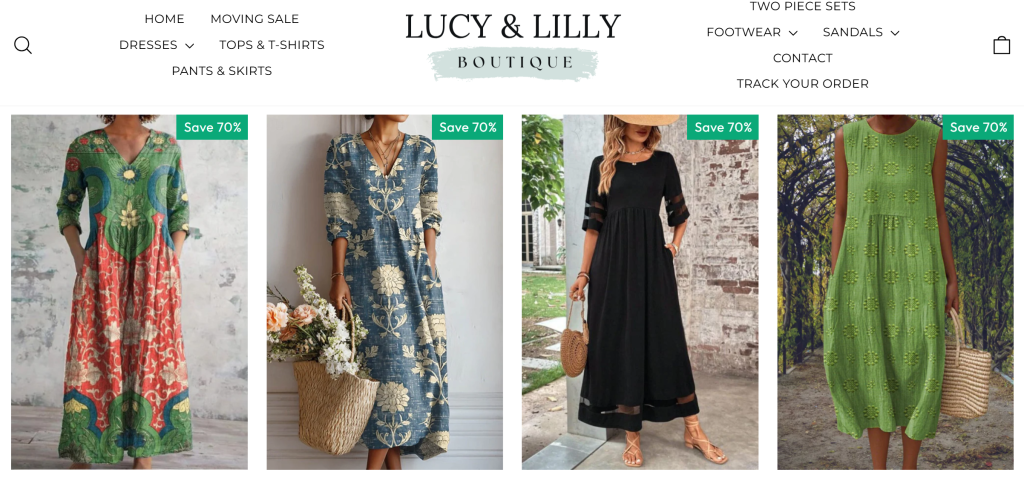
Lucy and Lilly Boutique is an online fashion store that sells women’s clothing and outfits at heavily discounted prices. The website currently advertises discounts of up to 70% off, positioning itself as an affordable destination for trendy women’s fashion.
While attractive discounts can appeal to bargain hunters, our investigation uncovered several warning signs that consumers should carefully consider before placing an order.
Quick Takeaway
- Lucy and Lilly Boutique sells women’s clothing and fashion outfits.
- The website advertises discounts of up to 70% OFF.
- The domain was registered in April 2026.
- The website has a very limited operating history.
- The domain is registered for only one year and expires in April 2027.
- New fashion stores offering steep discounts require additional scrutiny.
- Consumers should use payment methods that provide buyer protection.

Table of Contents
- Quick Takeaway
- What Is Lucy and Lilly Boutique Selling?
- Our Investigation Findings
- Red Flags Identified
- How the Scam Appears to Work
- Similar Scam Stores We’ve Investigated
- What To Do If You Ordered
- Frequently Asked Questions
- Conclusion
What Is Lucy and Lilly Boutique Selling?
Lucy and Lilly Boutique is an online women’s fashion retailer that offers a variety of women’s apparel. Its product catalog includes dresses, tops, sweaters, outerwear, bottoms, and other fashion items designed for women.
The store promotes boutique-style fashion and emphasizes discounted pricing across its collections.
Our Investigation Findings
Recently Registered Domain
WHOIS records show that Lucy and Lilly Boutique’s domain was registered in April 2026 and is scheduled to expire in April 2027.
Recently registered domains are commonly associated with higher-risk ecommerce operations because they lack an established reputation and long-term customer history. A short operating history makes it difficult for shoppers to verify the store’s reliability.
Short Registration Period
The domain is currently registered for approximately one year. Many legitimate businesses register domains for multiple years to demonstrate long-term commitment. While a one-year registration is not proof of fraudulent intent, it is frequently observed among temporary ecommerce stores.
Limited Operating History
Because the website was launched recently, there is little publicly available information regarding customer experiences, fulfillment reliability, product quality, or dispute resolution practices. Established retailers typically build a visible reputation over time through reviews, social media engagement, and independent mentions. New websites do not offer the same level of confidence.
Aggressive Discounting
The store prominently advertises discounts of up to 70% off. While promotional pricing is common in ecommerce, large discounts are frequently used to encourage impulse purchases before consumers conduct additional research about the retailer.
Red Flags Identified
Extremely New Domain
The website has only been active since April 2026.
Short Registration Period
The domain is registered for only one year, expiring in April 2027.
Limited Reputation History
There is little publicly available information demonstrating a long history of customer satisfaction or reliable order fulfillment.
Significant Discounts
The store advertises discounts of up to 70% off, which shoppers should evaluate carefully when purchasing from an unfamiliar retailer.
How the Scam Appears to Work
Based on patterns commonly observed among high-risk ecommerce stores, websites with similar characteristics often follow a predictable process.
Step 1: Attracting Shoppers With Large Discounts
Consumers are drawn to the website through advertisements, social media promotions, or search results highlighting substantial discounts and attractive product images.
Step 2: Creating a Professional Storefront
The website uses modern ecommerce design, product photography, and promotional messaging to create the appearance of a legitimate fashion retailer.
Step 3: Collecting Payments
Customers complete purchases and typically receive confirmation emails and order notifications, creating the impression that the order is progressing normally.
Step 4: Potential Fulfillment Issues
Complaints commonly reported against similar online stores include:
- Orders that never arrive
- Excessive shipping delays
- Products that differ from advertised descriptions
- Lower-quality items than expected
- Tracking information that provides limited updates
Not every customer will necessarily encounter these issues, but they are among the most common complaints associated with suspicious ecommerce operations.
Step 5: Refund and Support Challenges
Customers who experience problems may face delayed responses, complicated return procedures, or difficulties obtaining refunds.
Similar Scam Stores We’ve Investigated
Lucy and Lilly Boutique shares characteristics with the following stores:
Common factors include recently registered domains, limited operating history, and aggressive discount marketing.
What To Do If You Ordered
If you have already placed an order with Lucy and Lilly Boutique:
- Save all order confirmations and receipts.
- Take screenshots of product pages and advertisements.
- Monitor your payment account for unusual activity.
- Contact your payment provider if delivery issues arise.
- File a dispute or chargeback if the merchant fails to fulfill the order.
Frequently Asked Questions
Is Lucy and Lilly Boutique a scam?
We cannot definitively state that every transaction on the website is fraudulent. However, our investigation identified several warning signs that increase the overall risk associated with the store.
Why is the website considered high risk?
The primary concerns include its recent registration date, limited operating history, short domain registration period, and lack of an established reputation.
Is a new website always a scam?
No. Many legitimate businesses launch new websites every year. However, consumers should exercise greater caution when dealing with newly registered domains.
Should I buy from Lucy and Lilly Boutique?
Based on the available evidence, we recommend exercising caution and conducting additional research before making a purchase.
Conclusion
Lucy and Lilly Boutique exhibits several characteristics commonly associated with high-risk online stores, including a recently registered domain, limited operating history, a short registration period, and aggressive discount marketing.
While these factors do not prove fraudulent intent on their own, they increase the level of uncertainty surrounding the retailer. Until the website establishes a stronger reputation and longer track record, shoppers should proceed cautiously and use payment methods that offer buyer protection.