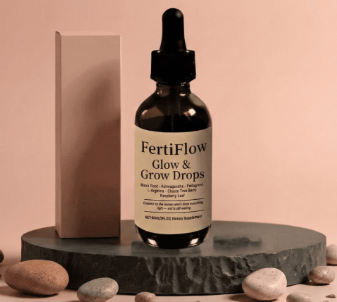

FertiFlow Glow & Grow Drops makes some bold fertility claims for a $59.99 supplement. Its website features women who supposedly conceived after months of trying, including one who claims she had a baby after unsuccessful IVF treatments. I wanted to know what was actually in these drops and whether there was any evidence behind those stories. What I found was a product with no clearly disclosed ingredient doses, several conflicting instructions on how much to take, and no clinical trial showing it improves pregnancy outcomes. The company also recommends using FertiFlow for three months, yet its stated refund window is only seven days after delivery.
Table of Contents
- About FertiFlow Glow & Grow Drops
- FertiFlow Ingredients and Dosage
- Does FertiFlow Glow & Grow Drops Work?
- Pregnancy Testimonials and IVF Claims
- Manufacturer and Product Testing
- FertiFlow Pricing and Refund Policy
- Customer Reviews and Complaints
- Side Effects and Safety
- What to Do If You Already Ordered
- My Verdict
About FertiFlow Glow & Grow Drops
FertiFlow Glow & Grow Drops is a liquid supplement marketed to women trying to conceive, particularly those concerned about irregular menstrual cycles, PCOS, declining egg quality, or previous fertility treatment failures. The product is sold through tryfertiflow.com and advertised as a natural way to support reproductive health, hormonal balance, and cellular energy. Each bottle reportedly contains 2 fluid ounces, approximately 60 mL, and is intended to last 30 days when taken at the advertised 2 mL daily serving. The company encourages women to follow a 90-day routine, suggesting that consistent use may help prepare the body for conception. Although FertiFlow is presented as nutritional support rather than a prescription fertility treatment, its advertising frequently associates the drops with successful pregnancies and improvements in reproductive function.
FertiFlow Ingredients and Dosage
FertiFlow advertises a combination of 15 ingredients, including CoQ10, myo-inositol, N-acetylcysteine (NAC), ashwagandha, L-arginine, maca root, raspberry leaf, fenugreek, selenium, vitamin D3, folate, vitamin B12, choline, vitamin C, and zinc. Several of these nutrients have been investigated for reproductive health, but I couldn’t verify a complete Supplement Facts panel showing their individual quantities. That makes it impossible to determine whether the drops contain doses comparable to those used in clinical studies. The website also contradicts itself about how much customers should take. One section recommends two full droppers, or 2 mL, daily, while others mention two drops once daily, ten drops under the tongue, or two droppers twice daily. Those instructions describe substantially different servings. The company also refers to both six ingredients and 15 ingredients in different promotional sections, without clearly explaining the discrepancy. For a product intended for women preparing for pregnancy, the manufacturer should provide one complete ingredient label and consistent dosing instructions.
Does FertiFlow Glow & Grow Drops Work?
Some ingredients in FertiFlow have been studied for fertility-related outcomes, but that doesn’t establish that the finished drops improve a woman’s chances of becoming pregnant. CoQ10 has been investigated in women undergoing assisted reproductive treatment, particularly those with diminished ovarian reserve, although evidence of improved live birth rates remains uncertain. Myo-inositol has been studied in women with PCOS for metabolic and ovulatory outcomes, while NAC has also appeared in reproductive health research. However, the results depend on the population, preparation, and dose. Without knowing how much of these substances FertiFlow contains, there’s no meaningful way to compare the product with those studies. Ashwagandha may have effects on stress, but reducing stress doesn’t necessarily improve egg quality or reverse infertility. Maca, raspberry leaf, and fenugreek also lack convincing clinical evidence for the pregnancy outcomes advertised here. I couldn’t find a published trial showing that FertiFlow itself improves ovulation, egg quality, IVF success, or live birth rates. I’ve encountered a similar evidence problem with other supplements, including Vital BP, where research involving individual ingredients was used to support claims about a finished formula that hadn’t demonstrated the same benefits.
Pregnancy Testimonials and IVF Claims
FertiFlow’s advertising relies heavily on emotional pregnancy stories. One testimonial describes a woman who supposedly conceived after 18 months of negative pregnancy tests. Another claims that a woman in her early forties improved her follicle-stimulating hormone (FSH) measurement from 15 to 9, obtained better-quality eggs, and eventually had a baby after previous IVF failures. The website also suggests that its approach could help women avoid expensive fertility treatments. I couldn’t independently verify these stories, the medical measurements, or the circumstances surrounding the reported pregnancies. Even if the testimonials came from genuine customers, they wouldn’t establish that FertiFlow caused the outcomes. Pregnancy can occur after previous unsuccessful cycles, and fertility measurements may fluctuate for reasons unrelated to supplements. A lower FSH reading also doesn’t prove that egg quality has improved or that ovarian aging has been reversed. The company would need properly designed clinical studies to substantiate these claims. Personal stories may be encouraging, but they aren’t reliable evidence that a supplement can overcome infertility or replace medical treatment.
Manufacturer and Product Testing
FertiFlow’s website states that the drops are bottled in a GMP-certified facility in the United States and undergo third-party purity testing. Those are manufacturing and quality-control claims, not evidence of fertility benefits. I couldn’t locate a batch-specific certificate of analysis identifying the laboratory, the substances tested, or the results for the finished product. I also couldn’t verify a clinical trial conducted on FertiFlow itself or identify a named medical research team responsible for developing and evaluating the formula. The website uses phrases such as clinically studied nutrients and refers to ingredients inspired by reproductive health research. That wording can sound reassuring, but it doesn’t mean the complete supplement has been clinically tested. Without independent testing documentation and a transparent Supplement Facts panel, customers have limited information about the product’s composition and quality.
FertiFlow Pricing and Refund Policy
FertiFlow Glow & Grow Drops is advertised for $59.99 per bottle, reduced from a stated regular price of $119.95. The company promotes consistent use over three months, encouraging customers to purchase enough bottles for the recommended routine. However, the stated refund conditions are much shorter than the period customers are encouraged to use the product. The website says orders can be cancelled or modified within six hours of purchase, while refund or replacement requests must be submitted within seven days after delivery, subject to approval. It also indicates that qualifying requests may not require customers to return the product. This creates a practical problem for someone hoping to assess the drops over 90 days. By the time they’ve followed the suggested routine, the stated refund window will have expired. A promotional guarantee shouldn’t be interpreted as a promise of a refund after three months unless the seller explicitly confirms that in its terms. Customers should also check the final checkout total and any additional purchase options before completing an order.
Customer Reviews and Complaints
FertiFlow’s website displays positive testimonials and claims that thousands of women have used the drops. Different promotional sections refer to more than 7,000 ratings or customers and over 10,000 mothers or customers, but I couldn’t independently verify those figures. The pregnancy stories are presented on the seller’s own website, where the company controls which reviews appear. I couldn’t find a substantial collection of independent customer experiences confirming improvements in fertility or pregnancy outcomes. I also couldn’t establish a consistent pattern of unauthorized charges, non-delivery, or refused refunds specifically involving FertiFlow. That distinction matters because a supplement can make unsupported health claims without necessarily being a fake store or a payment scam. The concern here is the gap between the company’s confident success stories and the limited independent evidence available to support them.
Side Effects and Safety
FertiFlow contains ingredients that deserve particular caution because the product is marketed to women who may become pregnant while using it. Ashwagandha has limited pregnancy safety data and is generally advised against during pregnancy. It may also interact with certain medications and has been associated with rare liver injury reports. Fenugreek can affect blood glucose and cause allergic reactions in susceptible people, while other botanical ingredients may be unsuitable for individuals taking fertility medications or managing existing medical conditions. Folate is important before and during early pregnancy, but FertiFlow doesn’t clearly establish the quantity supplied, so it shouldn’t be assumed to replace a properly formulated prenatal supplement. Women undergoing IVF, taking medication for PCOS, or actively trying to conceive should discuss the complete ingredient list with their healthcare professional before using the drops. Natural ingredients aren’t automatically safe during conception or pregnancy, particularly when their individual doses aren’t disclosed.
What to Do If You Already Ordered
If you’ve ordered FertiFlow and want to cancel, contact the seller immediately because the website states that order modifications are allowed for only six hours. If the drops have already arrived, check the delivery date and submit any refund request within the stated seven-day period. Keep your order confirmation, payment receipt, screenshots of the advertised guarantee, and copies of your communication with the seller. Ask for written confirmation of whether your order qualifies for a refund and whether a return is required. If you were charged an amount you didn’t authorize or the seller fails to resolve a legitimate payment dispute, contact your payment provider about the available dispute process. Anyone already using FertiFlow alongside fertility medication should consult their clinician before continuing. Women experiencing difficulty conceiving should also avoid delaying a medical fertility evaluation while waiting to see whether the advertised 90-day routine works.
My Verdict
I wouldn’t recommend FertiFlow Glow & Grow Drops as a fertility supplement. Its website promotes dramatic pregnancy outcomes without verified clinical evidence, doesn’t clearly disclose individual ingredient quantities, and provides contradictory dosing instructions. The seven-day refund window is also difficult to reconcile with the company’s recommendation to use the product for three months. I couldn’t establish that FertiFlow is a fake product or a confirmed payment scam, but its fertility claims aren’t adequately supported. Women trying to conceive would be better served by evidence-based fertility care and appropriately selected supplements rather than relying on these drops.