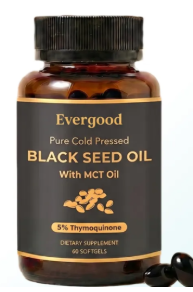
Evergood Black Seed Oil Review: Is Its 5% Thymoquinone Formula Really Worth the Extra Money?

Black seed oil has been around for centuries, so selling another bottle of it isn’t exactly groundbreaking. Evergood, however, has found a way to make its version sound rather different. The company advertises a 5% thymoquinone formula, claims it is ten times more potent than ordinary black seed oil, and adds MCT oil to keep it fresh. It also promises support for digestion, immunity, joint comfort and inflammation. That’s quite a lot to promise from a supplement made with two main oils. I sought to know what actually separates Evergood from the cheaper bottles already available, whether its impressive potency claim can be verified, and whether the money-back guarantee is as generous as the sales page makes it sound. Some of the answers are more interesting than the marketing.
What Is Evergood Black Seed Oil?
Evergood Black Seed Oil is a supplement made with Nigella sativa, commonly called black seed or black cumin, combined with MCT oil. It is sold as a softgel supplement rather than a bottle of liquid oil. The recommended serving is two softgels daily with food, and each pouch contains 60 softgels, enough for 30 days. Evergood says its formula is designed to support digestion, immune function, joint comfort, antioxidant protection and metabolic health. The brand also explains that it previously operated under the name Fable, so shoppers who encounter older Fable branding should know the company says it is the same product under a new name. The main selling point, though, isn’t simply the black seed oil. It’s the advertised 5% thymoquinone concentration.
The 5% Thymoquinone Claim: What Makes It Special?
Thymoquinone is one of the main bioactive compounds found in black seed oil, and it’s the ingredient Evergood uses to distinguish its formula from ordinary options. The company describes its 5% concentration as ten times more potent than standard black seed oil and says it uses high-altitude-grown Nigella sativa seeds to achieve that strength. It’s an attractive claim, especially for customers who don’t want to pay for an ordinary oil with an unknown active-compound concentration. But there’s a difference between advertising a percentage and showing customers exactly what is in the bottle. Evergood says every batch is independently tested for purity and potency, yet I couldn’t locate a publicly accessible, batch-specific certificate showing the actual thymoquinone result for the product being sold. Its FAQ confirms that quality checks are carried out but asks customers to contact the company for specific testing information. That doesn’t prove the 5% claim is false. It does mean shoppers cannot independently check the advertised concentration before buying.
Does Adding MCT Oil Make Evergood Better?
Evergood says thymoquinone is vulnerable to oxidation and that adding MCT oil helps preserve freshness and potency. That’s the company’s explanation for its formula, and it gives the product a more distinctive selling point than simply offering black seed oil in softgel form. However, the website doesn’t provide a stability study or other independent evidence showing how much longer its formula retains thymoquinone compared with ordinary black seed oil. MCT oil is a useful carrier ingredient, but its presence alone doesn’t prove that the finished supplement maintains a particular potency throughout its shelf life. The idea may be reasonable, but the evidence needed to demonstrate the claimed advantage isn’t publicly available.
Do the Health Benefits Hold Up?
Black seed oil isn’t an entirely unresearched ingredient. Studies involving Nigella sativa have explored its possible effects on blood sugar, cholesterol, blood pressure and inflammation. Some human trials have reported modest benefits, but the research is still limited, and results vary depending on the preparation, dose and condition being studied. That doesn’t support treating black seed oil as a cure for digestive problems, infections, joint pain or metabolic conditions. Evergood’s website goes further by promising improvements in digestion within one to two weeks, better joint flexibility after four to six weeks and broader benefits after three months. Those timelines sound reassuringly specific, but the company doesn’t provide clinical evidence showing that its own 5% formula reliably produces those results. Its customer testimonials describe improvements in bloating, energy and joint comfort, but personal stories cannot establish that the supplement caused those changes. Evergood may offer a concentrated form of a researched ingredient, but that is not the same as proving its full range of health promises.
Is Evergood Third-Party Tested and FDA Approved?
Evergood says every batch undergoes third-party testing for purity and potency and that its products are manufactured in a GMP-certified facility. Those are useful quality claims, but the company doesn’t make a batch-specific laboratory certificate readily available on the product page. Its FAQ says customers can request further testing information. There is also an FDA-related detail worth clearing up: Evergood says its products are made in an FDA-registered facility, but its own FAQ acknowledges that dietary supplements are not required to receive FDA approval before being sold. Facility registration does not mean the FDA has approved Evergood Black Seed Oil for effectiveness or confirmed its advertised health benefits. The company may have legitimate manufacturing arrangements, but customers should not confuse those claims with independent approval of the finished supplement.
Evergood Black Seed Oil Price and Discounts
The product page currently lists a one-time purchase at $32.99, reduced from $49.99, representing a claimed 34% saving. Buying multiple bottles brings the displayed per-bottle price down further, with the two-bottle one-time option advertised at $49.98 compared with a crossed-out $98.98. Those are substantial discounts, although I couldn’t verify the previous prices through an independent price history. There’s another detail worth catching: the single-bottle subscription option is displayed at $39.99, compared with $32.99 for a one-time purchase. In other words, the recurring option costs more for one bottle on the page I checked. That makes the subscription discount less attractive than the wording might suggest. The prices and promotions can change, so check the final checkout amount rather than relying on the savings displayed in the sales copy.
Is Evergood’s Subscription a Trap?
Evergood offers both one-time purchases and automatic refills every 30, 60 or 90 days. Subscribing is optional, and the company says customers can manage their orders through its subscription portal. However, the subscription automatically renews until cancelled. Its refund policy says customers must cancel before the end of the current billing period to avoid the next charge, while the FAQ directs customers to the online portal. This isn’t proof that Evergood deliberately traps customers, but it is important to select the one-time purchase option carefully if you only want to try the product. I would also take a screenshot of the checkout selection and order confirmation so there’s a record of whether you agreed to recurring deliveries.
The 90-Day Money-Back Guarantee Has Conditions
The big 90-day guarantee sounds generous until you read the actual terms. To qualify, customers must purchase a 90-day supply, take the supplement continuously at the recommended dosage and provide timestamped before-and-after photographs. The guarantee is limited to the first purchase, and the company says the request must arrive within 120 days of receiving the order. Shipping and processing costs are excluded. There’s also a separate general return policy allowing returns within 30 days, but only for unopened products with their original safety seal intact. Opened or used supplements cannot be returned under that standard policy. More confusingly, Evergood’s refund terms say the general policy takes precedence where the two sets of conditions conflict. That is a long way from the simple, no-questions-asked refund suggested by the sales page. Anyone relying on the guarantee should read the conditions before ordering rather than assuming an opened bottle can automatically be refunded after 90 days.
Evergood Black Seed Oil Customer Reviews
Evergood displays a 4.8 out of 5 rating and more than 1,600 product reviews on its sales page, alongside testimonials describing better digestion, improved energy and less joint discomfort. The feedback is encouraging, but these are reviews presented on the seller’s own website. They don’t independently verify the product’s thymoquinone concentration or establish that the reported improvements were caused by the supplement. Evergood also advertises more than 35,000 customers across its brand, but that figure is company-reported. I would treat the testimonials as customer experiences rather than proof that everyone should expect similar results.
Is Evergood Black Seed Oil Worth Buying? My Verdict
Evergood has chosen a sensible way to distinguish its black seed oil: a higher advertised thymoquinone concentration and an MCT oil blend. The problem is that the two features used to justify its premium positioning aren’t backed by publicly accessible batch results or stability evidence. Black seed oil itself has some promising research behind it, but the evidence doesn’t support the sweeping health promises on the sales page. The subscription pricing and complicated refund conditions also take some shine off the offer. Evergood may be a legitimate supplement brand, but I wouldn’t pay extra simply because it advertises 5% thymoquinone. I’d want to see a batch-specific laboratory report first. Until then, the strongest selling point remains a claim customers are being asked to take on trust.
Read Also >>> LumiVelle Gummies Review: Are These Viral Beauty Gummies a Scam?