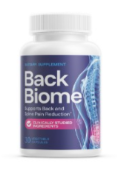

BackBiome isn’t marketed like a typical back pain supplement. Instead of talking only about joints or muscles, it says your back pain may actually start in your gut. According to the company, an unhealthy microbiome can trigger inflammation, increase nerve sensitivity, and contribute to ongoing back discomfort. That immediately caught my attention. The gut and inflammation are legitimate areas of scientific research. But saying they’re the root cause of most back pain is a much bigger claim. So, I looked beyond the headline.
Quick Verdict
- What I liked: The formula includes several ingredients that have individually been studied for inflammation and muscle support.
- What concerned me: The company stretches the gut-back connection much further than current evidence supports.
- Scientific backing: Some ingredients have research behind them, but I couldn’t find clinical trials on BackBiome itself.
- Would I recommend it? I’d be cautious, especially if you’re expecting it to solve chronic back pain.
- Bottom line: The ingredients make sense. The main marketing story is where I became more skeptical.
Table of Contents
- Quick Verdict
- BackBiome Isn’t Really Selling a Back Pain Supplement
- The Formula Wasn’t What Kept Me Reading
- Here’s Where I Started Asking Questions
- The Research Doesn’t Really Match the Story
- One Thing I Couldn’t Ignore
- What Other Buyers Should Keep in Mind
- Possible Side Effects
- Before Buying BackBiome, I’d Want Better Answers
- Better Alternatives I’d Consider
- A Pattern I Keep Seeing
- Is BackBiome Worth Buying?
- Frequently Asked Questions
BackBiome Isn’t Really Selling a Back Pain Supplement
It’s selling an explanation. Most back supplements focus on joints, cartilage, muscles, or inflammation. BackBiome goes in a different direction. The company says many cases of back pain begin with an unhealthy gut microbiome. According to its sales page, gut imbalance increases inflammation, irritates nerves, tightens muscles, and eventually leads to chronic back pain. That’s an interesting idea. It’s also much more complicated than the website makes it sound. Back pain has dozens of possible causes, including muscle strain, arthritis, disc problems, poor posture, injuries, osteoporosis, spinal stenosis, and nerve compression. Reducing all of that to one underlying cause feels like an oversimplification.
The Formula Wasn’t What Kept Me Reading
The ingredients are actually fairly reasonable. BackBiome contains a blend of:
- Probiotic Complex
- Turmeric Extract
- Boswellia Serrata
- Ginger Root
- Bromelain
- Magnesium Glycinate
- Black Pepper Extract to improve curcumin absorption.
None of those ingredients surprised me. Turmeric, Boswellia, ginger, and bromelain appear in many joint and inflammation supplements. Magnesium is commonly used for muscle function. The probiotics are what make this product different.
Here’s Where I Started Asking Questions
The company repeatedly describes the gut microbiome as the missing piece behind chronic back pain. There is some science linking gut health with inflammation. Researchers have also explored what is sometimes called the gut-joint or gut-spine axis. But that’s still an active area of research. It doesn’t mean restoring your microbiome will resolve most forms of chronic back pain. That’s where I think the sales page gets ahead of the evidence. The idea is interesting. The certainty isn’t.
The Research Doesn’t Really Match the Story
Several ingredients deserve credit. Curcumin from turmeric has been studied for inflammation. Boswellia has shown promise for joint discomfort in some studies. Magnesium may help normal muscle function.Probiotics can support digestive health and may influence inflammatory pathways in certain situations. Those are fair observations. What I couldn’t find was evidence showing that BackBiome’s specific combination has been clinically tested for chronic back pain. That’s an important difference. Research on ingredients isn’t the same as research on the finished supplement.
One Thing I Couldn’t Ignore
The company talks about targeting the “root cause” of back pain over and over again. Whenever I see phrases like that, I slow down. Back pain isn’t one condition. Someone with a herniated disc doesn’t have the same problem as someone with muscle strain. Someone with spinal arthritis has different underlying issues than someone recovering from an injury. A single supplement is unlikely to address every one of those situations.
What Other Buyers Should Keep in Mind
Even if the ingredients help reduce inflammation, that doesn’t automatically mean they’ll eliminate back pain. If your discomfort comes from poor posture, spinal degeneration, nerve compression, or structural problems, supplements may only play a small supporting role. That’s why realistic expectations matter. Products like this are better viewed as part of a broader plan that might include exercise, physical therapy, weight management, and medical care when necessary.
Possible Side Effects
Most BackBiome ingredients are generally well tolerated. Some people may notice:
- Mild digestive discomfort when starting probiotics.
- Upset stomach from turmeric or ginger.
- Loose stools in sensitive individuals.
- Possible interactions with blood-thinning medications because of turmeric, ginger, or bromelain.
Anyone taking prescription medication or managing a chronic medical condition should speak with a healthcare professional before starting a supplement.
Before Buying BackBiome, I’d Want Better Answers
A few questions stayed with me. Has the finished formula been tested in human clinical trials? How much of the improvement comes from the probiotics versus the anti-inflammatory ingredients? Why is there so much emphasis on the gut microbiome when many causes of back pain have nothing to do with gut health? Those are the questions I’d want answered before buying.
Better Alternatives I’d Consider
If your goal is supporting joint and back health, I’d also compare:
- Move Free Advanced + MSM
- Doctor’s Best Glucosamine Chondroitin MSM
- Nature Made Turmeric Curcumin
- NOW Boswellia Extract
A Pattern I Keep Seeing
I’ve noticed similar marketing in my reviews of BrainMary, BurnTide Supplement, and ProstAfense. The ingredients often have legitimate science behind them. The product itself is then presented as the solution to a much bigger problem than the available evidence actually supports.
Is BackBiome Worth Buying?
BackBiome isn’t built around fake ingredients. In fact, several ingredients are well known and have been researched for inflammation, muscle health, and joint support. What gives me pause is the story built around them. The gut-back connection is an interesting area of research, but I don’t think we’re at the point where it explains most chronic back pain or makes a supplement like BackBiome the answer. If you’re considering it, I’d treat it as a supportive supplement rather than a solution for persistent back pain. And if your pain is severe, getting worse, or has been lingering for months, I’d want a proper medical evaluation before putting too much faith in any supplement.
Frequently Asked Questions
Does BackBiome really work?
Some of its ingredients have been studied individually for inflammation and muscle support, but I couldn’t find published clinical trials showing that BackBiome itself relieves chronic back pain.
Is the gut really connected to back pain?
Research suggests gut health can influence inflammation, but there isn’t strong evidence that gut imbalance is the primary cause of most back pain.
Are there any side effects?
Some users may experience mild digestive discomfort, especially when starting probiotics. Ingredients like turmeric and bromelain may also interact with certain medications.
Can BackBiome replace physical therapy or medical treatment?
No. If your back pain is caused by a structural problem, injury, or another medical condition, a supplement should not replace appropriate medical care.
Is BackBiome worth buying?
The ingredients are more convincing than the marketing. I’d compare it with other joint-support supplements and keep realistic expectations before deciding.