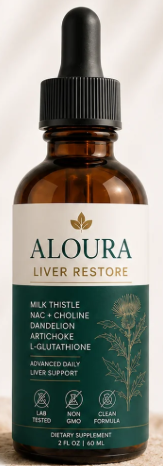

Aloura Liver Support promises to help people improve liver health, reduce bloating, restore energy, and achieve healthier liver enzyme levels with a daily liquid supplement. Its formula combines familiar ingredients such as NAC, glutathione, milk thistle, and dandelion root, while the sales page promises noticeable improvements within weeks and offers a 60-day money-back guarantee. However, looking beyond the health claims reveals several issues worth examining before placing an order. The checkout includes a recurring subscription option, the refund conditions don’t appear to match the headline guarantee, and almost identical formulas are marketed under several unrelated supplement brands. There are also unanswered questions about the company behind the store. Here’s what I found.
Table of Contents
- What Is Aloura Liver Support?
- The Ingredients Look Familiar, but the Claims Need Evidence
- The Subscription Is Where the Checkout Gets Concerning
- The 60-Day Guarantee Doesn’t Tell the Whole Story
- The Same Formula Appears Under Other Brand Names
- Who Actually Runs Aloura Health?
- What Are Customers Saying About Aloura?
- Is Aloura Liver Support a Scam?
- What to Do If You’ve Already Ordered
- Final Verdict
What Is Aloura Liver Support?
Aloura Complete Liver Support is a liquid dietary supplement sold through Aloura Health’s online store. Customers are instructed to take 2 mL daily, either directly under the tongue or mixed with a small amount of water. The brand presents this liquid format as a convenient, faster-absorbing alternative to capsules and claims that its ingredients support several aspects of liver function. Its marketing targets people experiencing fatigue, bloating, brain fog, or elevated liver enzymes, suggesting that these problems can persist even when someone eats well and exercises. Aloura then positions its supplement as the missing piece in their liver-health routine, but these symptoms can have several different causes, and elevated liver enzymes may require proper medical evaluation. That makes it particularly important to examine whether the product has credible evidence behind the benefits being advertised.
The Ingredients Look Familiar, but the Claims Need Evidence
Aloura lists glutathione at 50 mg, milk thistle extract at 200 mg, dandelion root extract at 200 mg, artichoke extract at 100 mg, beet root extract at 100 mg, and choline citrate at 50 mg. It also includes NAC, or N-acetyl cysteine, without clearly stating its individual amount, while six additional herbs—Chanca Piedra, astragalus, ginger, burdock, turmeric, and schisandra—are grouped into a 100 mg proprietary blend. Some of these ingredients have been studied for potential roles in liver or metabolic health, but research involving individual ingredients doesn’t automatically prove that Aloura’s particular combination will produce the same results. The product page connects the formula to healthier liver enzyme levels, reduced liver fat, improved bile flow, less bloating, clearer thinking, and better energy, even suggesting that customers may notice improvements within 30 days and changes in liver enzyme levels after 60–90 days. I couldn’t verify a published clinical trial testing the finished Aloura formula and demonstrating those outcomes. The undisclosed NAC quantity and proprietary blend also make it harder to evaluate the formula properly. Aloura may contain legitimate supplement ingredients, but the available information doesn’t establish that the finished product can repair liver damage, reverse fatty liver disease, or reliably improve someone’s blood test results.
The Subscription Is Where the Checkout Gets Concerning
Aloura lists a one-time purchase price of $39.95 alongside a Subscribe & Save option priced at $29.95. During the checkout inspection, the subscription option was selected by default, meaning the recurring purchase was already chosen before the customer actively selected it. This is an important detail because someone concentrating on the lower advertised price could overlook that they’re choosing a recurring order rather than a single purchase. The pricing creates another concern: Aloura advertises a 10% saving, yet the difference between $39.95 and $29.95 is approximately 25%, not 10%. The subscription configuration also includes a Shopify selling-plan identifier, confirming that the discounted option is connected to a recurring purchase arrangement. Subscription offers aren’t automatically problematic, but customers should be able to make that decision knowingly. Before paying, check whether the final order is a one-time purchase or a subscription, how frequently deliveries will arrive, what amount will be charged on renewal, and how cancellation works. I would also save screenshots of the selected option and final checkout details in case there’s a disagreement about what was authorised.
The 60-Day Guarantee Doesn’t Tell the Whole Story
Aloura’s product page promises a 60-day money-back guarantee and says customers can request a refund if they don’t notice improvements. It even suggests that empty bottles may qualify, making the offer sound relatively straightforward: try the supplement, decide whether it works, and ask for your money back if you’re dissatisfied. The written return conditions are less generous, however, with a shorter return window, requirements concerning the product’s condition and original packaging, and exclusions that may affect discounted purchases. This creates a significant difference between what the headline guarantee suggests and what a customer may encounter when requesting a refund. Someone could reasonably rely on the 60-day promise, open the bottle, use the supplement for several weeks, and then discover that the written conditions don’t support the same expectations. If the product page says empty bottles are eligible but the return policy restricts refunds to unused products, the seller needs to explain which terms actually apply. I would ask Aloura to confirm in writing whether opened or empty bottles qualify, which deadline applies, whether discounted orders are excluded, and who pays return shipping before placing an order.
The Same Formula Appears Under Other Brand Names
Another detail worth examining is that Aloura’s formula doesn’t appear to be unique. The same ingredient sequence and listed quantities show up under other liver-support brands, including Purelia, Purella, Livora, Ocuvana, and Rosalyssa. This suggests a shared formula or white-label arrangement, where a supplier manufactures a product that different sellers market under their own brand names. That business model isn’t automatically a problem, since plenty of legitimate supplement companies use contract manufacturers, but it raises questions about what actually distinguishes Aloura’s product from the alternatives. The company says its supplement is made in a GMP-certified facility and is third-party tested for purity and potency, yet I couldn’t verify a publicly available, batch-specific certificate of analysis showing the results for the product customers receive. A meaningful certificate should identify the product or batch and explain what was tested, rather than simply repeat a general quality assurance statement. Aloura should also make the manufacturer’s identity, manufacturing location, and testing documentation easy for customers to verify. Without those details, buyers are largely being asked to accept the seller’s quality claims on trust.
Who Actually Runs Aloura Health?
The store identifies Tarot Club LLC as the business operating Aloura Health and provides the email address info@alourahealth.store. It also publishes customer-service hours, but the publicly available store information doesn’t clearly identify the LLC’s jurisdiction, registered business address, or a customer-service telephone number. That makes independent verification more difficult because an LLC name alone isn’t always enough to identify the correct legal entity; businesses in different jurisdictions can use identical or similar names. There are also unanswered questions about the product’s manufacturing and fulfilment arrangements. The site refers to shipping from an Ohio warehouse, but that statement doesn’t identify the manufacturer or independently establish where the supplement was made. These gaps don’t prove that Tarot Club LLC is fictitious or that every order is fraudulent, but they leave customers with limited information about the business they’re trusting with their payment details and potentially recurring charges. For a company selling a health supplement through a subscription model, that’s a meaningful transparency problem.
What Are Customers Saying About Aloura?
Customer feedback provides another reason to be cautious, although the available evidence is limited. When I checked Aloura Health’s Trustpilot profile, it contained one review with a one-star rating. The reviewer alleged that the product’s country of origin had been misrepresented and described difficulty obtaining a refund, including a problem with the company’s email contact. A single review cannot establish how most customers are treated, and those allegations haven’t been independently verified, but the complaint raises questions that overlap with the other concerns here: product-origin transparency, refund handling, and whether customers can reach the company when something goes wrong. Aloura also displays positive customer reviews and testimonials on its own website, including stories about improved liver enzyme results, reduced bloating, and increased energy. These testimonials may describe genuine customer experiences, but they are hosted by the seller and shouldn’t be treated as independent clinical evidence. Without access to the underlying medical records or a verified study of the finished formula, there’s no reliable way to establish that Aloura caused the improvements described. The available feedback is therefore too limited to judge overall customer satisfaction confidently, leaving the checkout and refund concerns as the more concrete reasons for caution.
Is Aloura Liver Support a Scam?
I wouldn’t describe Aloura as a proven fraud based on the information available, but there are several problems with the way the product is marketed and sold. The subscription option was selected by default, the displayed prices don’t support the advertised discount percentage, and the refund promise appears more generous than the written conditions. The limited business disclosures, repeated formula, and absence of verified clinical evidence for the finished product add to the uncertainty. My assessment is that Aloura Liver Support is a high-risk purchase, particularly for anyone who doesn’t want recurring charges or is buying it in the hope of correcting a liver condition. I would avoid ordering unless the seller provides clear written subscription terms, consistent refund conditions, verifiable business details, and stronger evidence supporting its health claims. If you’re researching similar products, my guide to the warning signs of supplement scams explains why checkout defaults, refund contradictions, and repeated formulas deserve attention.
What to Do If You’ve Already Ordered
If you’ve already purchased Aloura, start by checking your order confirmation and bank or card statement for any indication of recurring deliveries, the renewal amount, and the billing interval. If you don’t want future orders, contact the company through its published support email and request cancellation in writing, keeping a copy of your request and any response. Also save the original product page, order confirmation, and refund terms that applied when you ordered, as these records may become useful if there’s a disagreement about billing or a refund. If another payment appears after you’ve cancelled, or you believe you never knowingly authorised recurring billing, contact your card issuer or payment provider and explain the situation using those records. If you’re seeking a refund, ask the seller to confirm the applicable deadline and return requirements before sending anything back. Don’t rely solely on the guarantee displayed in an advertisement when the written policy says something different. Anyone with elevated liver enzymes, a fatty liver diagnosis, or symptoms that cause concern should also avoid using Aloura as a substitute for medical care.
Final Verdict
Aloura Liver Support has more problems than I would be comfortable overlooking. The formula contains familiar ingredients, but the seller hasn’t established that the finished product delivers the specific results promised in its marketing. More importantly, the preselected subscription, inconsistent discount figures, and conflicting refund expectations make the purchasing process less transparent than it should be. The business also leaves important questions unanswered about its legal identity, manufacturing arrangements, and product testing. None of these findings independently proves fraud, but together they create a pattern of avoidable uncertainty. I would skip Aloura Liver Support. There are too many unanswered questions about the offer itself, and the available evidence doesn’t justify trusting its stronger liver-health claims.