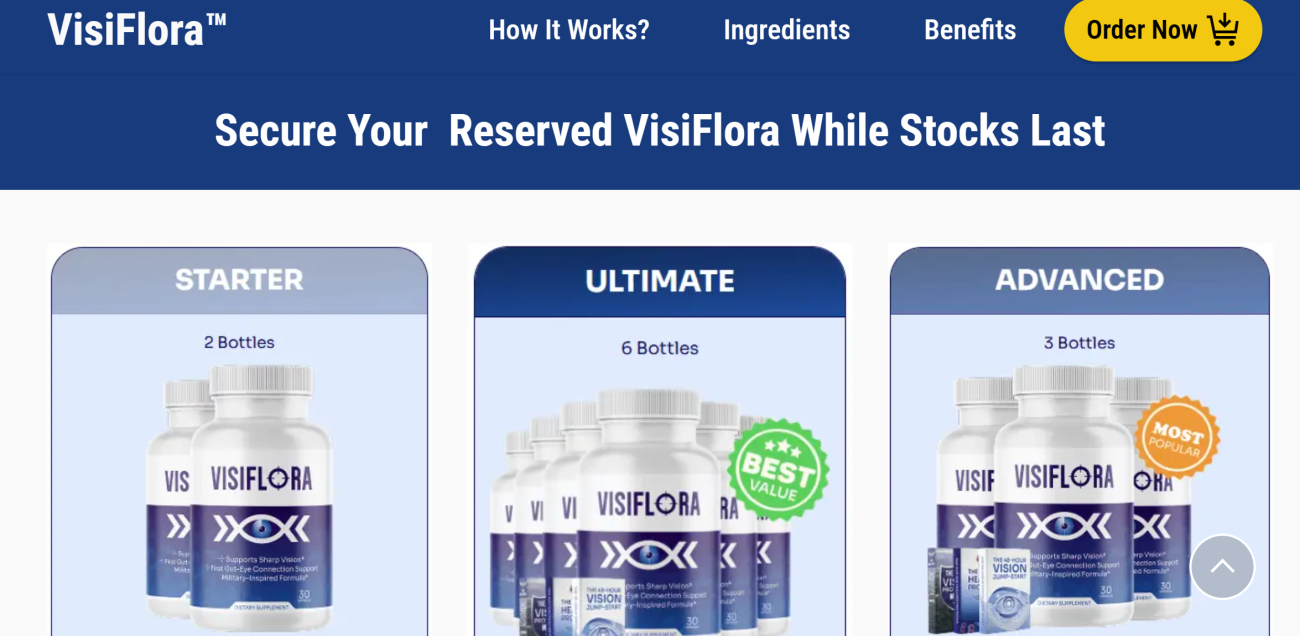
I first ran into VisiFlora the same way I’ve been running into a lot of these supplements lately, not through research circles or clinical discussions, but through aggressive ads that feel like they follow you around the internet. What caught my attention wasn’t even the product at first, but the story being built around it, this idea that vision problems aren’t really about the eyes at all but something deeper, hidden, and supposedly overlooked. Whenever I see that kind of framing, I know I’m about to fall into a marketing funnel rather than a straight product explanation.
Quick Take
VisiFlora is positioned as a vision support supplement built around the gut-eye connection idea, but once I broke it down, it feels less like a clinical breakthrough and more like a modern supplement funnel built on selective science, emotional framing, and vague biological storytelling.
What Is VisiFlora?
VisiFlora is marketed as a daily eye health supplement combining nutrients like lutein, zeaxanthin, vitamins, and plant-based antioxidants. On paper, it looks like a typical vision formula, but the angle is different. Instead of focusing only on macular or retinal support, it reframes vision decline as something linked to gut health, inflammation, and internal imbalance. That shift in framing is important because it turns a simple nutrient supplement into something that sounds like a full-body “root cause” solution.
Why I Looked Into It
What pulled me in wasn’t curiosity about another eye supplement, but repetition. The same narrative kept showing up across ads and review-style pages: hidden toxins, declining vision, and a simple daily fix that supposedly solves everything. I’ve seen similar funnel patterns before while breaking down products like Neurovive and Gelatide Drops, where the product itself is almost secondary to the story built around it.
What I Noticed
The structure behind VisiFlora’s marketing is extremely consistent. It starts with fear around worsening vision, then shifts the cause away from the eyes, and finally introduces a “scientific explanation” involving gut bacteria, toxins, and inflammation. It feels less like information and more like a guided narrative designed to move someone from concern to purchase. Another pattern is ingredient borrowing. Instead of proving the full formula works as a system, it leans on nutrients like lutein and zeaxanthin that already have independent research behind them. I’ve seen this same pattern while reviewing Bioma Probiotics and Purelia Papaya Powder, where ingredient science gets stretched into product certainty.
Ingredients Breakdown
VisiFlora is built around a blend of common eye-health nutrients and plant compounds typically associated with antioxidant support.
Lutein and Zeaxanthin
These carotenoids are commonly linked to macular health and protection against oxidative stress in the eyes. They are widely used in eye supplements because they help filter blue light and support retinal function.
Vitamin A
Vitamin A plays a role in maintaining normal vision, particularly in low-light conditions. It is essential for the function of the retina, but excessive intake can also become problematic, which makes dosage transparency important.
Vitamin C and Vitamin E
Both act as antioxidants that help protect cells from oxidative stress. In eye formulas, they are typically included to support overall tissue health and reduce free radical damage.
Bilberry Extract
Bilberry is often used in vision supplements because it contains anthocyanins, compounds believed to support circulation in the eyes and help with visual fatigue.
Astaxanthin
Astaxanthin is a powerful antioxidant sometimes used for eye strain and visual endurance. Some studies suggest it may help reduce fatigue in people who spend long periods looking at screens.
The challenge with formulas like this is not the ingredients themselves. Most of them are commonly used in eye supplements. The real issue is that the exact dosages are not clearly disclosed, which makes it difficult to evaluate whether the amounts match levels that have been studied in clinical research.
Product Claims vs Reality
The claims sound appealing on the surface: better clarity, reduced strain, improved long-term vision support, and internal balance through gut-related pathways. But the gap shows up when you compare that to actual clinical research. Yes, certain nutrients used here are linked to eye health, but they are studied in precise dosages and controlled conditions. VisiFlora does not clearly disclose those dosages, which makes evaluation difficult. The gut-eye connection is still an emerging research topic, not a confirmed mechanism that a supplement can directly target in the way the marketing suggests. So, what you end up with is not false science, but stretched interpretation.
What Real Users Are Saying
When I looked past the marketing and focused on actual user feedback, the pattern was pretty underwhelming in a grounded way. Most people describe very mild effects at best, usually things like slightly less eye strain after long screen time or a bit more comfort when reading. But even then, the wording is often unsure, like they can’t fully tell if it’s the supplement or just normal variation in how their eyes feel day to day. A lot of users also report no noticeable change at all, even after a few weeks of consistent use. Those reviews tend to be neutral rather than negative, more like “I didn’t really feel anything” than anything stronger. Overall, there’s no strong, consistent user signal here. Just a mix of subtle positives, indifference, and a lot of uncertainty.
Pros and Cons
On the positive side, VisiFlora includes ingredients commonly associated with eye health and is positioned as an easy daily supplement without prescription requirements.
On the downside, transparency is a major issue. The lack of clear dosages limits real evaluation. The marketing also leans heavily on emerging science as if it is already settled fact, which creates a perception gap.
It reminds me of patterns I noticed while researching NeuroLabs Peptides, where the language often runs ahead of the actual evidence.
Better Alternatives to Consider
If the goal is simple eye support, more established lutein and zeaxanthin-based formulas with clear dosing tend to be easier to assess and compare. In my experience reviewing supplements like Memo Brew and NeuroLyfe Sleep Gummies, the more reliable options are usually the ones that don’t rely on complex storytelling to explain basic function.
Is VisiFlora Worth The Buy?
It depends entirely on expectations. If someone is expecting noticeable vision improvement, that’s not realistic here. At best, it sits in the general wellness category, where effects are subtle, inconsistent, and highly individual. So, it becomes less about “does it work” and more about whether you’re okay with mild, uncertain benefits wrapped in a strong narrative.
Final Take
After breaking it all down, what stands out most is not the formula itself but the marketing architecture around it. VisiFlora is built on a modern supplement storytelling system that blends real nutrients with emerging science and emotional framing. It is persuasive, structured, and clearly designed to convert interest into sales. But underneath that, it still behaves like a typical general eye supplement with a more elaborate explanation attached.
FAQs About VisiFlora
Is VisiFlora scientifically proven?
The individual ingredients have research, but the full formula does not appear to have independent clinical validation.
Does VisiFlora improve vision?
Most reported effects are mild and related to comfort rather than actual vision improvement.
Is VisiFlora a scam?
Not in the strict sense, but the marketing does exaggerate certainty and leans heavily on selective science.
How long does it take to see results?
Users who report benefits usually mention gradual changes over several weeks rather than immediate effects.
