Audifort Drops are heavily marketed online as a natural way to support hearing and reduce ringing in the ears. The messaging is everywhere: calm your ears, reduce tinnitus, hear more clearly again, all without drugs or medical procedures. For anyone dealing with constant buzzing, humming, or ear discomfort, that promise is understandably tempting. But before buying, it’s important to slow down and separate what Audifort actually is from what the marketing suggests it can do.
This review looks at how Audifort Drops are positioned, what kind of evidence supports those claims, and where the red flags start to show. The goal here is to give you a clear, realistic picture so you can decide with your eyes open.
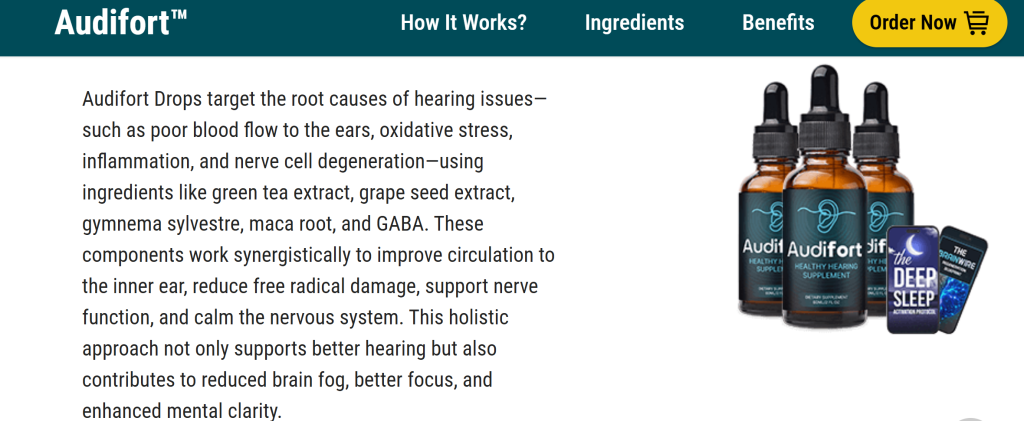
What Audifort Drops Are Supposed to Do
Audifort Drops are sold as a dietary supplement designed to “support” hearing health. According to promotional material, the product aims to reduce ringing or buzzing in the ears, promote ear comfort, calm the nervous system, and support overall auditory wellness. It’s often described as a natural alternative for people experiencing age-related hearing changes, noise sensitivity, or tinnitus.
What’s important to understand is that Audifort does not claim to be a medicine, even though some of the language used in ads can blur that line. The product is positioned as a wellness supplement, not a treatment.
Where the Claims Start to Get Fuzzy
Many of Audifort’s claims are built around broad, non-specific phrases. Words like “supports,” “promotes,” and “helps maintain” are common in supplement marketing because they sound reassuring without requiring hard proof. The problem is that these phrases don’t explain how much improvement to expect, how long it takes, or whether the effects are measurable in any clinical way.
There’s a big difference between supporting general health and actually improving a condition like tinnitus or hearing loss. The marketing often leans toward the second idea without clearly stating that the product hasn’t been proven to do that.
Ingredients vs Finished Product Reality
Audifort Drops contain a blend of vitamins, minerals, and plant-based compounds commonly associated with nerve health, circulation, and stress response. Individually, some of these ingredients have been studied for their general role in the body. That’s where most of the confidence behind the product comes from.
However, this is a critical point many buyers miss: research on individual ingredients does not equal proof that a finished supplement works as advertised. Dosage, formulation, absorption, and interactions all matter. There is no publicly available, peer-reviewed clinical study showing that Audifort Drops as a product improve hearing, eliminate tinnitus, or repair auditory nerves.
Lack of Product-Specific Clinical Evidence
Despite references to “science” and “research-backed ingredients” in ads, there is no transparent clinical trial data demonstrating that Audifort Drops deliver the results implied by their marketing. No audiograms, no controlled studies, no published medical trials tied specifically to this formula.
This doesn’t mean the product is harmful, but it does mean the strongest claims rely on association and storytelling rather than verified outcomes. That’s a red flag worth paying attention to, especially when dealing with something as complex as hearing health.

Common Marketing Red Flags
One noticeable pattern is how heavily Audifort relies on testimonials. Stories about people “hearing clearly again” or “finally enjoying silence” are emotionally powerful, but they’re subjective. There’s no way to verify whether these experiences were measured medically or whether other factors played a role.
Another concern is the way urgency is used. Limited-time offers, bundle discounts, and warnings about “missing out” are classic supplement marketing tactics. They’re designed to encourage quick decisions, not careful evaluation.
It’s also worth noting that supplements like Audifort are not approved by health authorities to treat hearing loss or tinnitus. Any suggestion that it functions like a medical solution is misleading, even if it’s phrased subtly.
Does Audifort Drops Actually Work?
The honest answer is that results, if they happen at all, are likely mild and highly individual. Some users may feel less bothered by ear noise or experience a general sense of calm that makes tinnitus feel less intrusive. Others notice no difference even after weeks of use.
What Audifort does not do, based on available evidence, is restore hearing, cure tinnitus, or reverse long-term auditory damage. Anyone expecting dramatic or guaranteed results is likely to be disappointed.
There’s also a risk in relying on supplements alone. Persistent ringing, hearing loss, or ear discomfort can have many causes, including medical conditions that require professional evaluation. A supplement should never replace seeing an audiologist or ENT specialist.
Consumer Experience and Feedback Trends
Independent user feedback outside official sales pages tends to be mixed. Some people describe subtle improvements or better coping with symptoms. Others report no noticeable change and question whether the product was worth the cost. Complaints about auto-ship programs or refund confusion also appear in discussions, which is another point buyers should watch closely.
Because many reviews are published on affiliate sites, they’re not always reliable indicators of real-world effectiveness.
Final Thoughts: Should You Buy Audifort Drops?
Audifort Drops are best understood as a general wellness supplement marketed toward people with hearing-related concerns. While some ingredients may support overall nerve or cellular health, there is no strong scientific evidence proving that the product delivers the significant hearing improvements suggested by its advertising.
Conclusion: Manage expectations carefully. Audifort Drops may offer mild subjective support for some users, but they are not a proven solution for tinnitus or hearing loss. If the claims sound too good to be true, it’s because the evidence doesn’t fully support them.
Also Read >>> Citrus Burn Supplement Reviews: The Truth Behind the Claims
