If you’ve been seeing Wild Harvest Gut Cleanse online lately, it doesn’t really show up like a normal digestive supplement. It shows up more like a “gut reset” solution, with strong claims about flushing parasites, reducing bloating, improving energy, and cleansing the body from the inside out.
When I first looked at it, what stood out immediately was how heavily the marketing leans into internal “toxins” and parasite-style framing, even for general gut discomfort like bloating or fatigue.
In this review, I’ll break down what Wild Harvest Gut Cleanse actually is, what’s inside it, how the claims are being presented, and whether there’s anything solid behind the detox narrative.
Quick Takeaway
- Wild Harvest Gut Cleanse is marketed as a 2-step herbal gut and parasite cleanse
- Ads focus on bloating, toxins, digestive discomfort, and “gut reset” claims
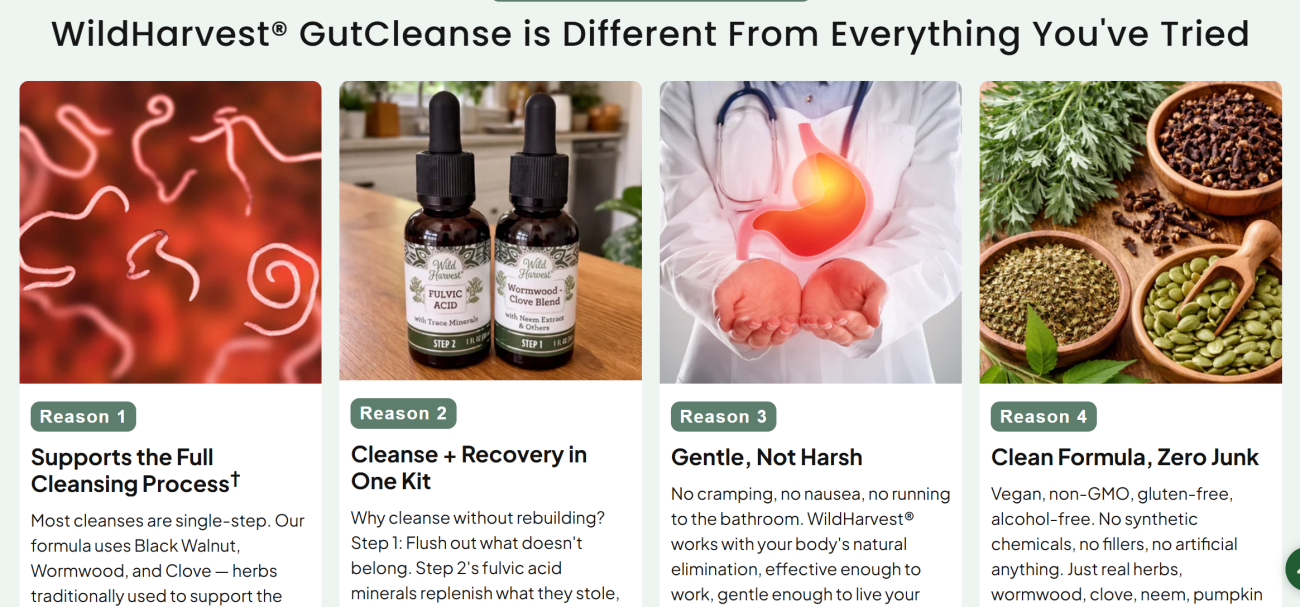
- Ingredients include wormwood, clove, black walnut, neem, and fulvic acid
- There is no strong clinical evidence supporting parasite cleanse supplements for general gut health claims
- The funnel relies heavily on detox framing and emotional “internal cleansing” marketing
What Wild Harvest Gut Cleanse Is and Claims To Do
Wild Harvest Gut Cleanse is a two-step herbal supplement system marketed for digestive cleansing and gut balance.
The first step typically uses herbs like wormwood, clove, black walnut, and neem, while the second step introduces fulvic acid and trace minerals. The marketing presents this as a structured protocol meant to “clean the gut environment” and improve digestion over a cycle.
The claims go beyond basic digestion support. The product is positioned as something that helps flush out unwanted organisms, reduce bloating, improve energy levels, and restore what it calls “gut balance.” That framing places it closer to a detox system than a simple digestive supplement.
Ingredient Breakdown
The formula relies heavily on traditional herbal ingredients that are often used in wellness and folk medicine contexts.
Wormwood, clove, and black walnut are frequently associated with parasite cleanse protocols in alternative health spaces. Neem is also widely used in traditional herbal systems, and fulvic acid is often marketed for mineral and detox support.
The important thing here is not whether these ingredients exist or have traditional uses, but what the actual evidence says about the claims being made. There is no strong clinical proof that multi-herb parasite cleanse combinations can reliably “remove parasites” or provide broad detox effects in people without confirmed infections.
Most modern medical guidance also emphasizes that parasite infections are relatively rare in developed regions and require proper testing rather than self-diagnosis through symptoms like bloating or fatigue.
The Marketing Angle
This is where Wild Harvest becomes much easier to understand. The entire funnel is built around the idea that common digestive symptoms are actually signs of something hidden happening inside the gut. So instead of positioning it as general digestive support, the marketing reframes bloating, fatigue, and discomfort as evidence of internal buildup that needs cleansing. Once that idea is planted, the supplement is introduced as a structured solution that “cleans the system” over time. It’s a very emotional angle because it takes everyday digestive issues and turns them into something more urgent and serious.
The “Clinically Backed” Illusion
The marketing uses a lot of scientific and wellness-style language around gut lining support, detox pathways, lymphatic drainage, and microbial balance.
It sounds technical, but most of it is presented in a way that doesn’t connect to specific clinical trials on the actual product.
Individual herbs may have general research behind them in different contexts, but that is not the same as proving that a multi-step parasite cleanse produces the outcomes described in the ads.
Domain Setup and Transparency
Wild Harvest operates through a direct-to-consumer funnel structure rather than a clearly established retail or pharmaceutical brand with transparent long-term corporate disclosure.
Domain creation date is not clearly verifiable from a single stable brand source, as the product appears through rotating landing pages and funnel-based storefronts rather than one consistent brand domain history.
That kind of setup is common in viral supplement campaigns where branding and sales pages are frequently adjusted depending on ad performance.
Emotional Selling Tactics
The marketing relies heavily on internal discomfort framing. It focuses on bloating, heaviness, digestive irregularity, fatigue, and the feeling that something “isn’t right” internally.
Then it introduces the idea that these symptoms are signs of something deeper that needs to be “cleared out.” That shift is what turns a basic digestive concern into a full detox narrative.
Urgency and Funnel Tactics
Like many supplement funnels in this category, Wild Harvest uses urgency-based messaging such as limited availability, timed discounts, and batch-based claims.
These tactics are designed to reduce hesitation and push quicker decisions before deeper research happens.
Real User Experience Pattern
With products in this category, experiences tend to vary widely.
Some users report feeling lighter or less bloated, while others report no noticeable difference at all.
But what’s important is that improvements like reduced bloating can also come from diet changes, hydration, or natural variation in digestion, which makes it difficult to isolate the supplement as the cause.
There is also concern in broader medical discussions about unnecessary detox or cleanse products potentially disrupting normal gut balance when used without clear medical need.
A Pattern I Keep Seeing
Wild Harvest fits the same structure I’ve already seen in SlimTides, Tivoras, Brain Honey, GlicoDex, Sonvyra Microneedle Patch, and Fumepure.
Different health angle, same underlying system. Emotional discomfort, hidden internal cause, scientific-sounding explanation, and a simple supplement-based solution presented as a reset.
Once you’ve seen enough of these funnels, the pattern becomes very predictable.
Is Wild Harvest Gut Cleanse Legit or a Scam?
Wild Harvest Gut Cleanse appears to be a real herbal supplement product that is physically sold online. The concern is not existence, but positioning.
The parasite cleanse and detox claims go beyond what current medical evidence strongly supports for general gut health improvement.
Conclusion
Wild Harvest Gut Cleanse is marketed like a deep internal reset system that clears toxins and restores gut health through a structured herbal protocol.
But once the detox framing is stripped away, it looks much closer to a multi-herb digestive supplement being positioned through aggressive cleanse-based storytelling.
FAQ
Does Wild Harvest Gut Cleanse remove parasites?
There is no strong clinical evidence that over-the-counter parasite cleanse supplements reliably remove parasites without medical diagnosis and treatment.
Is parasite cleansing necessary?
In most modern healthcare guidance, parasite infections are uncommon and should be confirmed through medical testing rather than self-diagnosis.
Do gut cleanses actually work?
Some people may notice changes in digestion, but results are inconsistent and not guaranteed.
Are the ingredients safe?
Ingredients like wormwood and clove are used in herbal traditions, but effects can vary and should be used cautiously, especially in high doses or long cycles.
Is Wild Harvest legit?
It appears to be a real product, but the marketing claims around detox and parasite cleansing are stronger than the supporting evidence.
